Planning a visit to Ancient Olympia? If so, this post has everything you need: local tips, practical info, and answers to the questions travelers ask most.
I’m originally from this part of Greece (the village of Krestena), so Ancient Olympia (Greek: Αρχαία Ολυμπία) has always had a special place in my heart.
I spent many of my childhood summers here, and I still visit often, most recently in August 2025.
Olympia is the birthplace of the Olympic Games, and even after all these years, walking through the ruins still gives me chills.
If you’re planning your trip, here are the most important things to know before visiting Ancient Olympia, plus a short itinerary for a 2-day visit to the area.
Before we get into all the practical tips, here’s a walk-through of Ancient Olympia so you can get a feel for the site.
This post includes links that may be affiliate links. If you choose to make a purchase through them, I may earn a small commission at no extra cost to you. Please see my disclaimer/privacy policy for more information.
Olympia Quick Facts
- Stay at Hotel Europa Olympia, a fantastic hotel with a swimming pool.
- Watch my YouTube Video: Tour in Ancient Olympia.
- Best time to visit: Morning
- Minimum time needed: 2–3 hours (site and museum)
- Ticket: €20
- Kid-friendly: Yes
- Worth staying overnight: Yes.
FAQ – Everything You Should Know Before Visiting Ancient Olympia

Last time I visited, I spent three days in the area exploring Ancient Olympia and all the nearby villages, the Kaiafas lake and beaches, and the Alphios river.
Over the years, I’ve noticed that visitors tend to ask the same questions about the site and the region, so I’ve put together the most helpful ones below.
You might also find my guide on how much my three-day trip to Olympia cost; it breaks down transportation, food, accommodation, and entrance fees.

1. Where is Ancient Olympia, and how do I get there?
Ancient Olympia is in the western Peloponnese. You can drive from Athens in about 3.5–4 hours or come by tour, bus, or even as a stop on a Peloponnese road trip.
It is 263 kilometers (163.4 miles) west of Athens.
If you rent a car, you can get there either through the Tripoli National Road or by following the northern coastline of the Peloponnese through Patras.
2. What are the roads like when driving from Athens to Ancient Olympia?
The national roads connecting Athens to Ancient Olympia are in excellent condition and very easy to drive on.
The route follows modern highways with smooth, well-marked lanes, parking areas with free-to-use restrooms, and frequent service stations.
Keep in mind that several parts of the drive include toll roads, so it’s good to have some cash or a card ready.
Overall, it’s a safe, comfortable, and straightforward drive—perfect for a road trip to Olympia.

3. How far is Ancient Olympia from Katakolo?
Roughly 35–40 minutes by car or bus (around 32 km/20 mi).
If you are visiting with a cruise ship, you can also book a local guided tour from Katakolo that will provide transportation and a licensed guide if you want one.
4. How much time do I need to visit Ancient Olympia?
You’ll want at least 2–3 hours to explore the archaeological site and museum.
If you also want to walk around the modern town or stop at nearby attractions, plan for a full day.

5. How much is the entrance ticket?

General admission is €20, and the ticket includes both the archaeological site and the museum.
EU children and adults up to 25 years old enter for free, and children under 18 from all countries also get free admission.
Free entry days:
– The first and third Sunday of every month from November to March
– On March 6th, April 18th, May 18th, the last weekend of September, and October 28th.
If you are visiting during peak season (July, August), it is better to purchase your tickets in advance to avoid long lines.
You can buy tickets through the official Acropolis ticket website, but remember that tickets are non-refundable and the date cannot be changed once booked.
If your plans aren’t fully set, it’s usually safer to book through platforms like GetYourGuide, where ticket options often include free cancellation and more flexibility.

6. What can I see at the site?
Ancient Olympia is filled with iconic ruins, and each major monument tells a story of athletics, religion, and ancient engineering.
Here are the most important landmarks you’ll see during your visit:
Temple of Zeus – Built between 470 and 456 BC, a masterpiece of the Doric style. Inside stood the chryselephantine Statue of Zeus, one of the Seven Wonders of the Ancient World.
Temple of Hera (Heraion): One of the oldest temples; housed important offerings, including Praxiteles’ Hermes.
Stadium of Olympia – Hosted the ancient Olympic Games and the Heraia. Capacity around 45,000 spectators. The stadium is 192.27 m long and has no seats—spectators sat on the ground.
Entrance to the Stadium (Krypte): The vaulted passage used by athletes and judges.
Gymnasium: Large training area for runners and athletes, protected from bad weather.
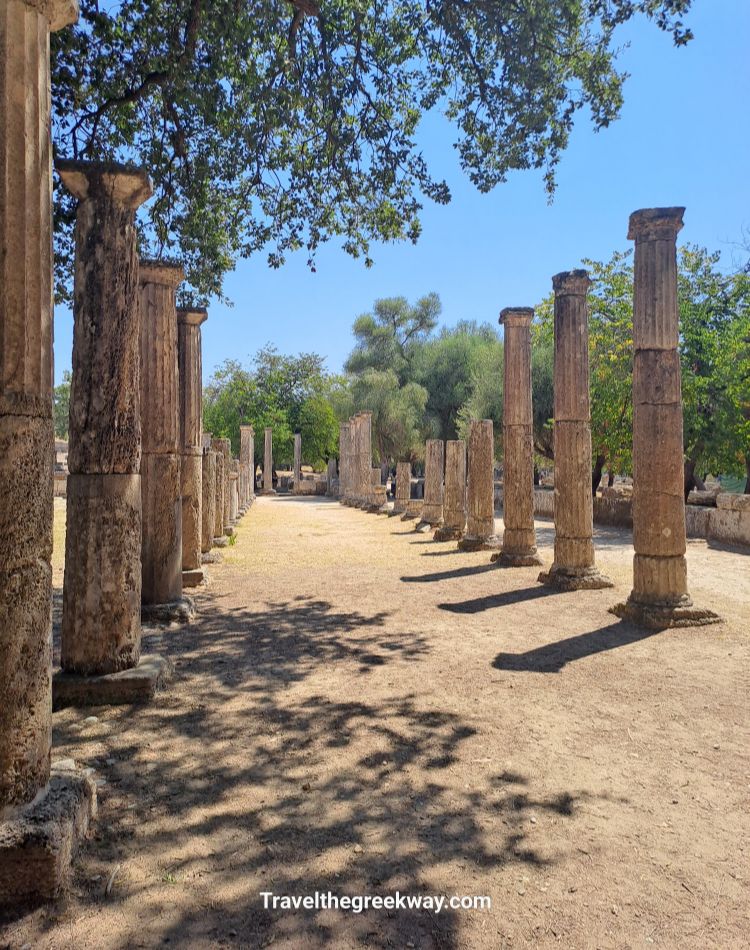
Palaestra: The wrestling, boxing, and pankration training complex.
Bouletérion: Meeting place of the council of Elis; athletes took their sacred oath here.
Prytaneion: Administrative center where the sacred flame of Hestia burned continuously.
Leonidaion: Guesthouse for VIPs of the Olympic Games.
Workshop of Phidias: Where Phidias created the Statue of Zeus; a cup inscribed “I belong to Phidias” was found here.
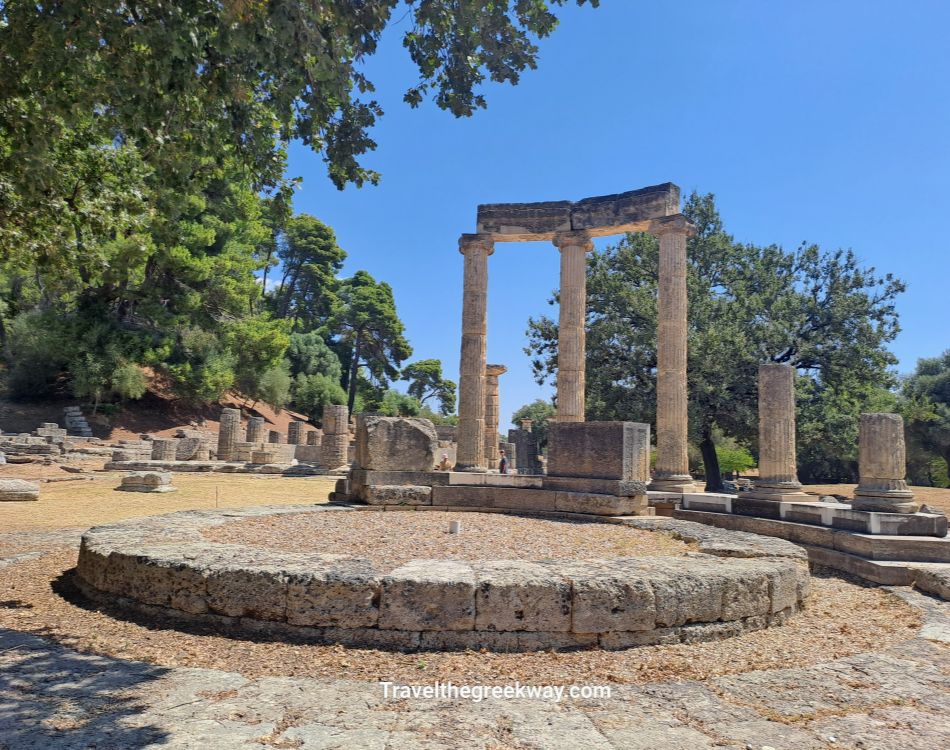
Philippeion: The only circular building in the Altis, dedicated by Philip II and completed by Alexander the Great.
Metroön: Temple dedicated to the mother of the gods (Rhea/Cybele).
Nymphaeum (Herodes Atticus) – Monumental fountain and water supply system of Roman times.
North Baths / Kronion Baths – Ancient bathing complex.
The villa of Emperor Nero and more.
7. What events were included in the Ancient Olympic Games?
The Ancient Olympic Games were athletic competitions between Greek athletes as a Panhellenic event, bringing together people who lived spread out across a wide region and were not united under one single city-state.
There were multiple games and events in the Ancient Olympic Games:
Running events: Stadion sprint, diaulos double race, dolichos long run, hoplite race with shield, boys’ race, maiden race (the latter, as mentioned by traveler Pausanias).
Wrestling (Pále): Three throws to win, ground fighting until surrender, technique over strength.
Boxing (Pygmachia): Leather-wrapped hands, violent strikes, climax exchange of blows, the winner is the last standing.
Pankration: A mix of wrestling and boxing, grappling, holds, finger strikes, the toughest Olympic event.
Pentathlon: Running, long jump, wrestling, discus, javelin with ankylē.
Equestrian Events: Chariot racing, horse riding, hippodrome start mechanism.
8. Who could compete in the Ancient Olympics?
Only Greek-born men were allowed to compete. Later on, the Romans joined in too, because they had conquered Greece.
Women and enslaved people weren’t even allowed to watch.
And in true dramatic ancient-Greek fashion, if a woman was caught sneaking in, the punishment was being thrown off a cliff.

9. Is the archaeological museum worth it?
Absolutely! It has some breathtaking exhibits.
It’s full of original sculptures from the temples and especially the stunning pediments of the temple of Zeus, tools, weapons, and the famous Hermes of Praxiteles statue.
It helps you understand what you just saw at the site.

10. What is the Olympic flame and its connection to Ancient Olympia?
The Olympic Flame is lit at the archaeological site of Ancient Olympia and symbolizes peace and unity in the modern Games.
After the lighting ceremony, it travels across Greece with torchbearers running through major cities before being flown to its final host country.
The modern Olympic Flame first appeared and was used at the 1928 Amsterdam Games.
The torch-lighting ceremony and the torch relay were later introduced during the 1936 Berlin Summer Olympics.

11. When is the best time to visit Ancient Olympia?
Honestly, any season works. However, in summer, it gets really hot, especially in the middle of the day.
12. Can I visit Ancient Olympia as a day trip from Athens?
Technically, yes, but it’s a long day. The drive takes about 3.5 to 4 hours each way.
If you can, staying overnight makes the trip way more relaxed and enjoyable.

13. Is Ancient Olympia good for kids or families?
Yes! It’s open, easy to walk, and kids often love the stadium and statues. The museum is also family-friendly.
14. Can I visit Ancient Olympia without a guide?
Absolutely. You can walk around on your own, but a guide or audio tour can really help bring the history to life.

15. Is there shade at the site?
There is, but not everywhere. Bring water, a hat, and sunscreen—especially if visiting in summer.
The museum is air-conditioned, and a great way to cool off.
16. Are there places to eat near Ancient Olympia?
Yes! The modern village has plenty of tavernas, coffee shops, and bakeries, all within easy walking distance from the site.
Just keep in mind that these places are very touristy and can get crowded, and they don’t always feel super traditional.
Personally, I prefer stopping at tavernas a bit outside the center—places like Makrisia or Krestena, where the food is more authentic and the atmosphere feels much more local.

17. Is it worth staying overnight in Ancient Olympia?
Yes. It’s peaceful, close to the site, and there are several places to stay in the area.
18. What are the best hotels to stay in Olympia?
By far, the best hotel in Olympia is Hotel Europa Olympia with a large swimming pool.
If you prefer more budget options, then you should check out Anesi Rooms To Rent and Prytanio.

19. When did they excavate the ruins in modern times?
The first excavation started in 1871 and was funded by the German state.
20. What should I wear when visiting the site?
Comfortable walking shoes are a must. In warmer months, wear light clothes, a hat, and sunglasses.

21. Can I combine Olympia with other nearby attractions?
Definitely. You can visit Kaiafas Lake, Kaiafas Beach, the village of Krestena, or even head into the mountains to Dimitsana.
22. How accessible is the site for people with limited mobility?
Some parts have uneven ground, but there are accessible routes and the museum is wheelchair-friendly.
23. Can you give a quick history of Ancient Olympia?

Ancient Olympia was a major religious sanctuary dedicated to Zeus and became the birthplace of the Olympic Games in 776 BC, and it really peaked around 576 BC.
The Games were organized every four years.
Some of the other areas in Greece with sanctuaries that included Games are:
Delphi with a sanctuary dedicated to Apollo, Nemea with a sanctuary dedicated to Zeus and Isthmia with a sanctuary dedicated to Poseidon.
For over a thousand years, athletes from all over the Greek world came here to compete in honor of the gods.
The site grew into a powerful cultural and religious center, filled with temples, statues, and monuments.
It declined during the early Christian era and was eventually closed by Theodosius I in 395 AD, before earthquakes and floods buried much of it until its rediscovery in the 18th and 19th centuries.
24. What is not allowed in Ancient Olympia?
Pretty much the same rules apply here as in most archaeological sites in Greece — and around the world.
Avoid touching the marble. Even gentle contact can cause long-term damage.
Strollers aren’t permitted on the archaeological site.
No pets are allowed unless they are certified service dogs.
Only water is allowed inside—no snacks, soft drinks, or food.
Smoking and vaping are strictly prohibited.
Keep noise low. No music or loud sounds.
Commercial photography requires prior approval.
Don’t remove, move, or disturb anything—ancient objects, stones, or even natural materials.
Stay on the marked paths. Wandering off the designated areas is not allowed and can lead to penalties.
2 to 3-Day Itinerary Idea (Corinth, Olympia, Kaiafas, Tripoli)
I spent three days in Olympia in August 2025, and it turned out to be one of the highlights of my summer in Greece.
If you’re planning a visit, this simple itinerary follows exactly what I did—mixing the big historic sights with plenty of relaxed wandering, good food, and time to enjoy the quiet Peloponnese countryside.
Day 1: Athens, Corinth Canal, Ancient Corinth, Rio Castle, Overnight in Olympia
- Start your trip with a quick stop at the Corinth Canal for photos.
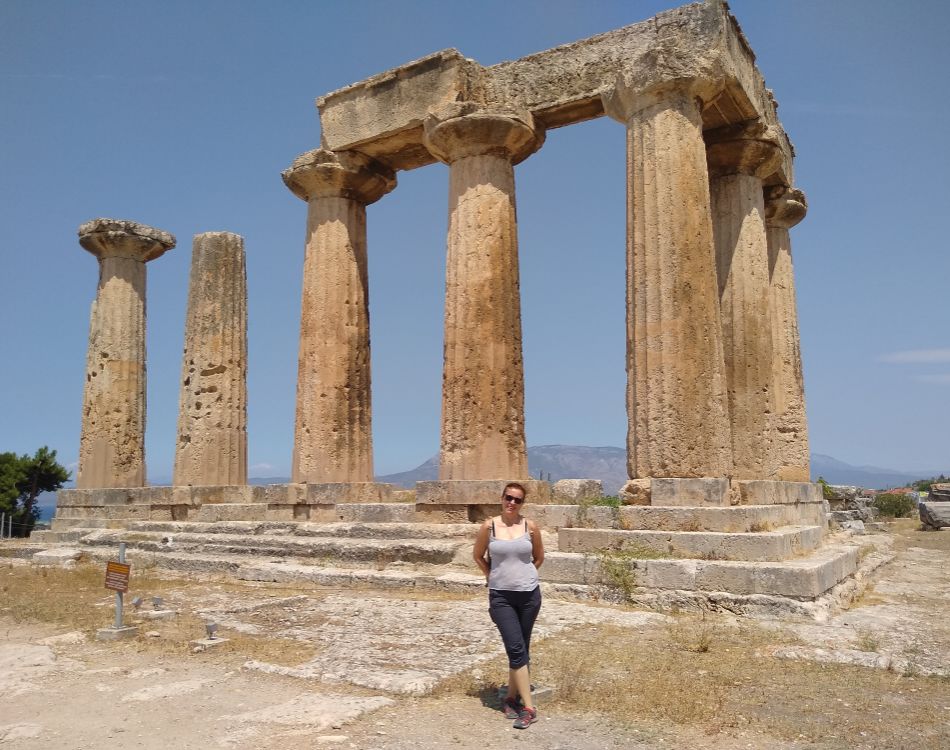
- Continue to Ancient Corinth to explore the Temple of Apollo and the Apostle Paul’s Bema.
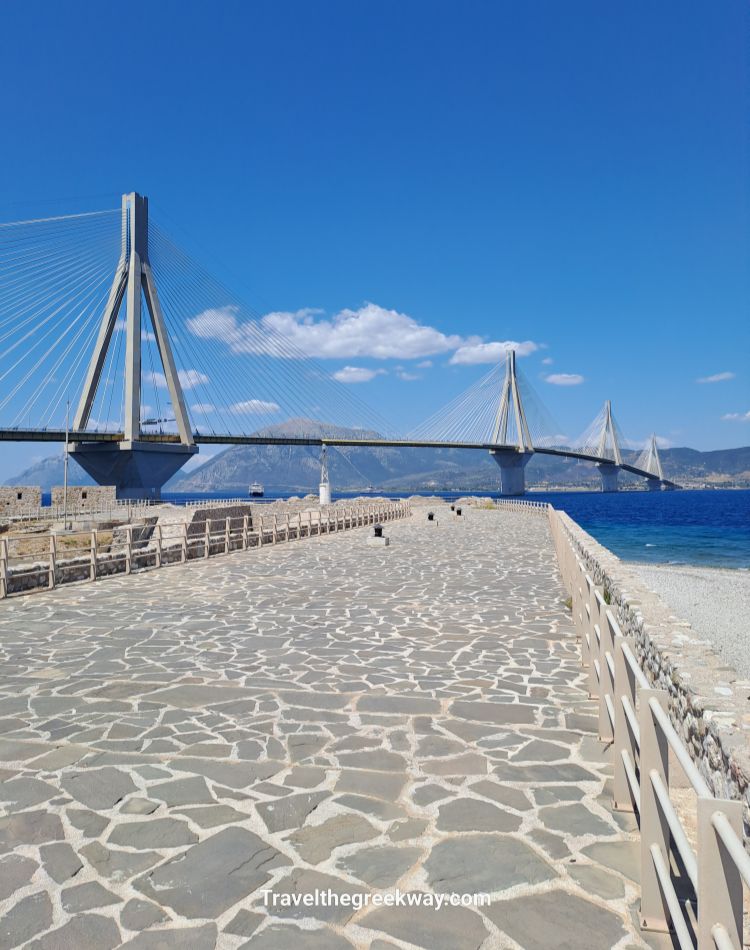
- Head west toward the Rio Castle (Castle of Rion) for sea views and a walk around the fortress.
- Arrive in Olympia, check in at your hotel, and enjoy dinner in the village.
Day 2-3: Olympia, Kaiafas Lake, Kaiafas Beach, Krestena → Tripoli (return route)
- Visit Ancient Olympia and the Archaeological Museum early, before crowds.
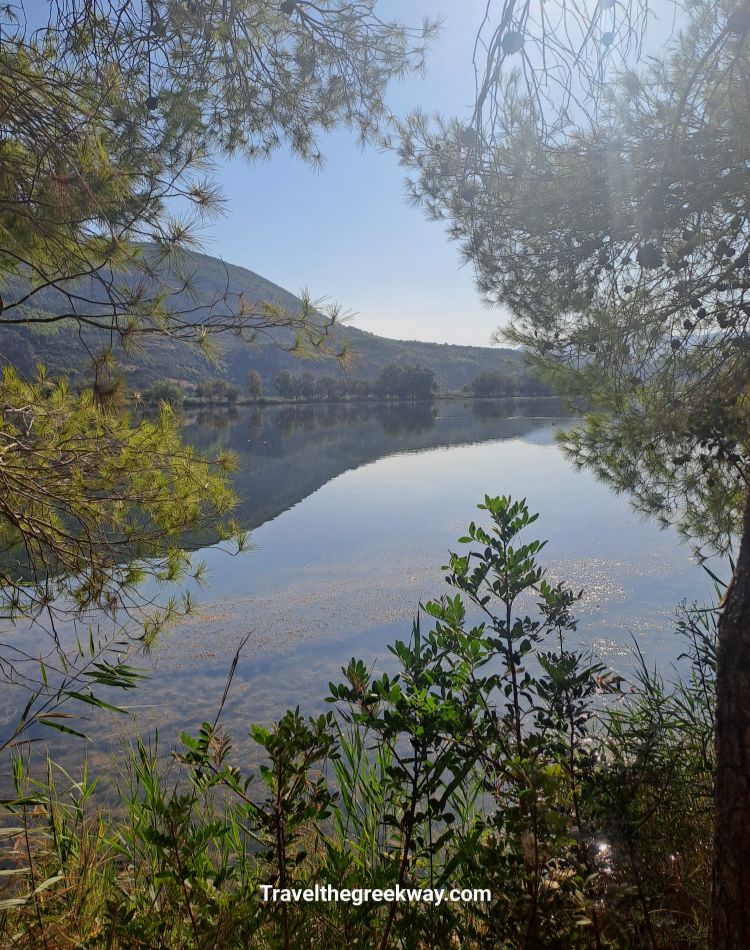
- Drive to Kaiafas Lake for a quiet nature stop.
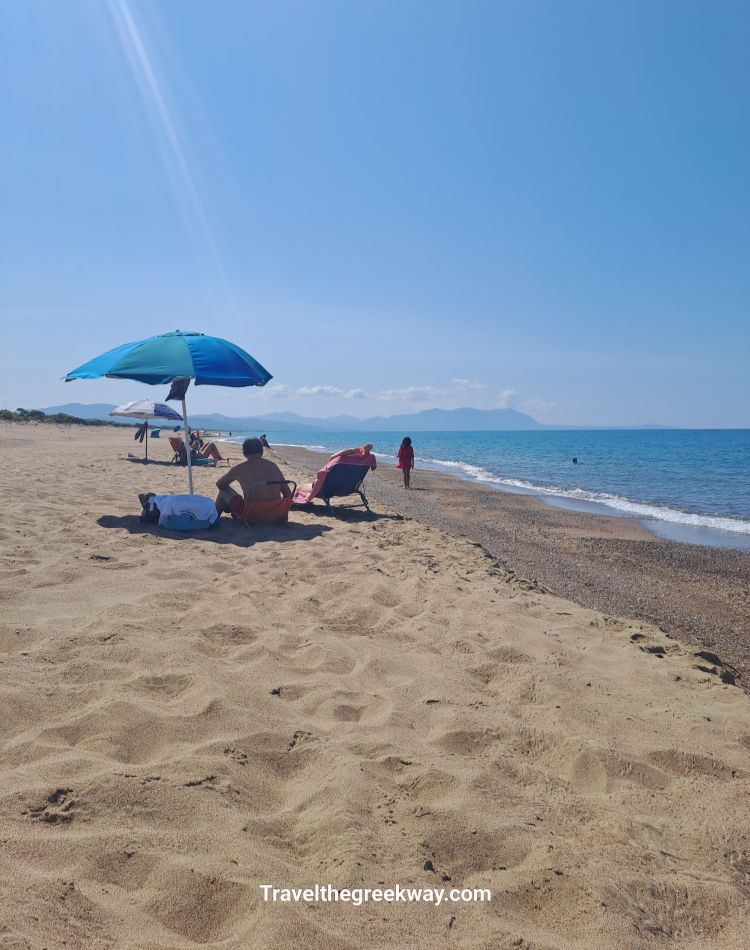
- Continue to Kaiafas Beach for a swim or seaside walk.
- Stop in Krestena for lunch or coffee in the village square.
- Return to Athens through Tripoli, a scenic inland route with mountain views.
Final Thoughts on Ancient Olympia
Ancient Olympia is one of Greece’s most important archaeological sites and a must-see for anyone interested in history, mythology, or the origins of the Olympic Games.
With stunning nature, a world-class museum, and a peaceful atmosphere, it’s one of the most rewarding places to visit in the Peloponnese.
Planning a full trip? Check out my guides to nearby villages, beaches, and road trip ideas across the Peloponnese!
Join Our FB Group & Subscribe to My YouTube Channel!
For more travel to Greece tips and beautiful destinations in the Greek islands please join my FREE Facebook Group or SUBSCRIBE to my YouTube & TikTok channels for amazing videos of Greece! Happy and safe travels, Evgenia.
Essential Greek Travel Info
- ‘Hello’ and ‘Thank You’ in Greek: “Ya sou” and “Efharisto”
- Booking.com: I use Booking.com mostly for Europe.
- All-Inclusive Resorts in Greece
- Rent an Affordable Car in Greece
- Athens Metro Website (timetables and ticket info)
- Trains (Hellenic Train)
- Public Buses KTEL
- Get Your Guide: For all your day or multi-day tours and city guide needs, I use Get Your Guide
- Emergency Numbers Anywhere in Greece: AMBULANCE 166 – FIRE 199 – POLICE 100– EMERGENCY NUMBER 112
