One of the most debated topics for any traveler heading to the Aegean is flying vs. ferry to the Greek islands. As you plan your trip, you’re likely wondering: which is actually better?
Is the 45-minute flight truly a time-saver, or is the 5-hour ferry ride the “real” start of your vacation?
As a Greek local who has spent a lifetime hopping between these islands, I’ve taken hundreds of ferries and regional flights.
In this guide, I’m breaking down the logistics, the 2026 costs, and the “experience factor” from a local’s perspective to help you decide which mode of transport is right for your Greek adventure.

This post includes links that may be affiliate links. If you choose to make a purchase through them, I may earn a small commission at no extra cost to you. Please see my disclaimer/privacy policy for more information.
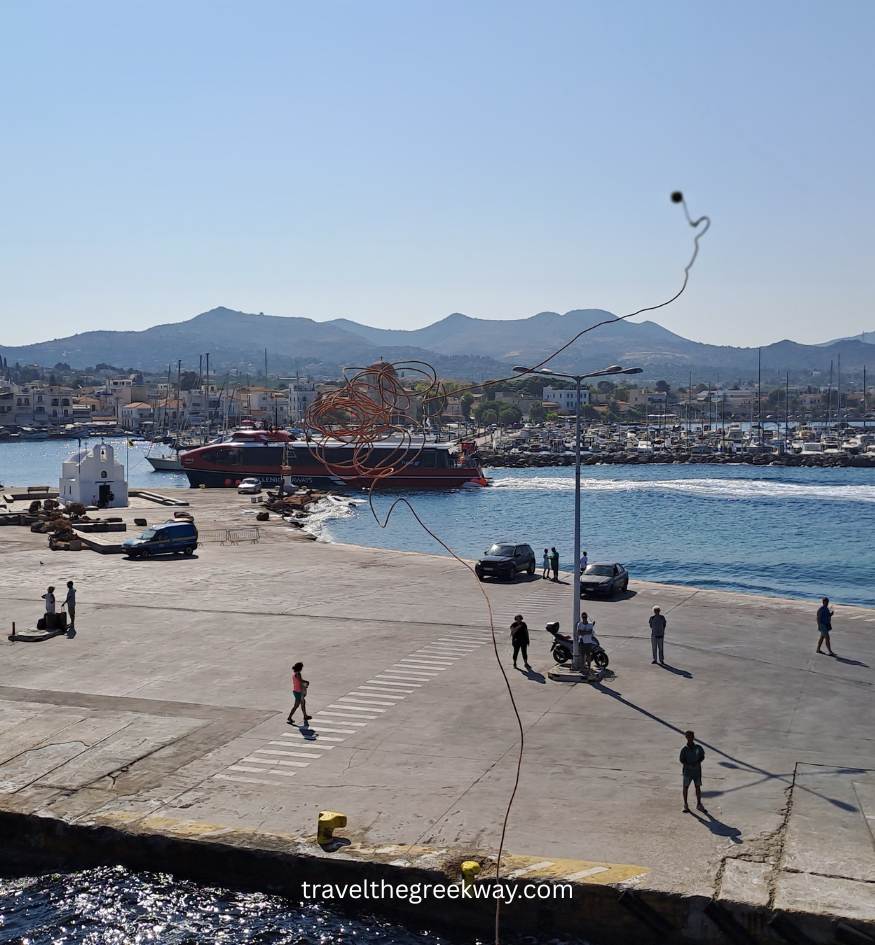
Flying vs. ferry to the Greek islands
| Feature | Flying (Athens to e.g., Naxos) | High-Speed Ferry | Conventional Ferry |
| Travel to Port/Airport | 1 Hour | 30-45 Minutes | 30-45 Minutes |
| Wait Time | 1.5 – 2 Hours | 30 Minutes | 30 or 60 minutes if you have a car |
| Actual Journey | 45 Minutes | 3.25 Hours | 5 – 6 Hours |
| Total Door-to-Door | ~4 Hours | ~5 Hours | ~7.5 Hours |
The Reality Check: If you take a high-speed ferry, you only lose about one hour compared to flying.
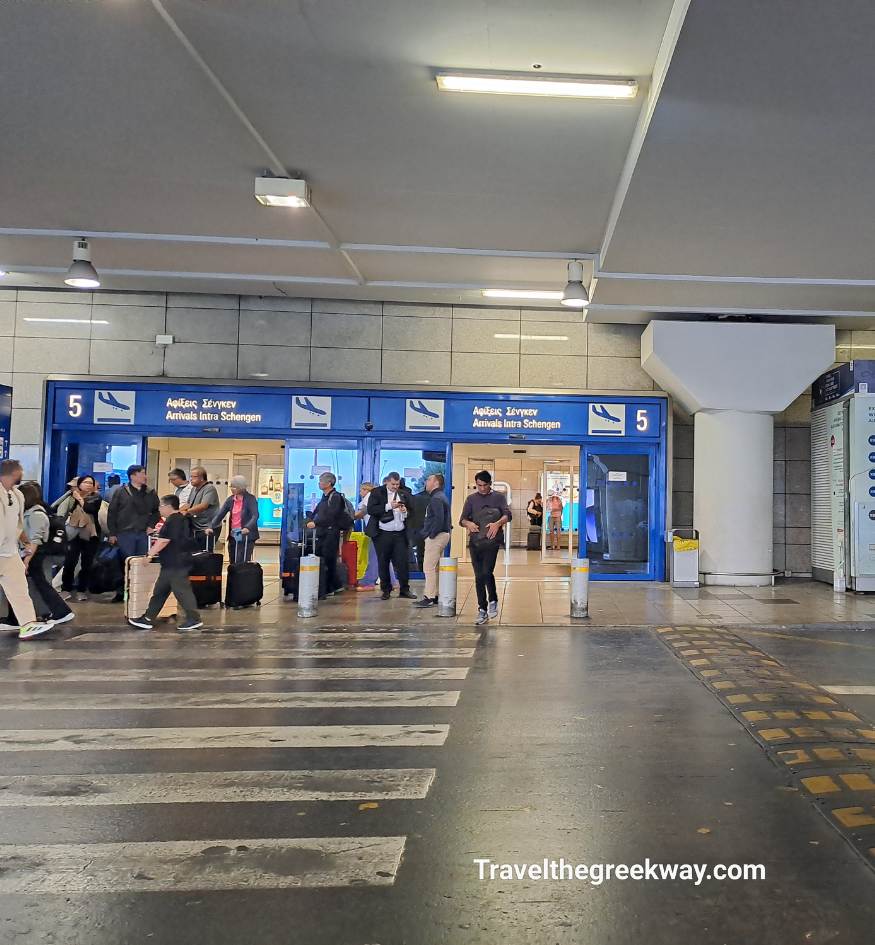
However, if you are already at the airport (ATH) for a layover, flying is significantly more efficient.
If you are staying in downtown Athens (near Plaka or Monastiraki), the Port of Piraeus is only a short metro ride away, making the ferry much more tempting.
Option 1: The Ferry Experience (The “Slow Road”)
For many, the ferry isn’t just transport; it’s a Greek ritual.
The “Blue Star” Conventional Ferry
The larger conventional ferries (Blue Star, Zante, Minoan Lines) are floating mini-cities.
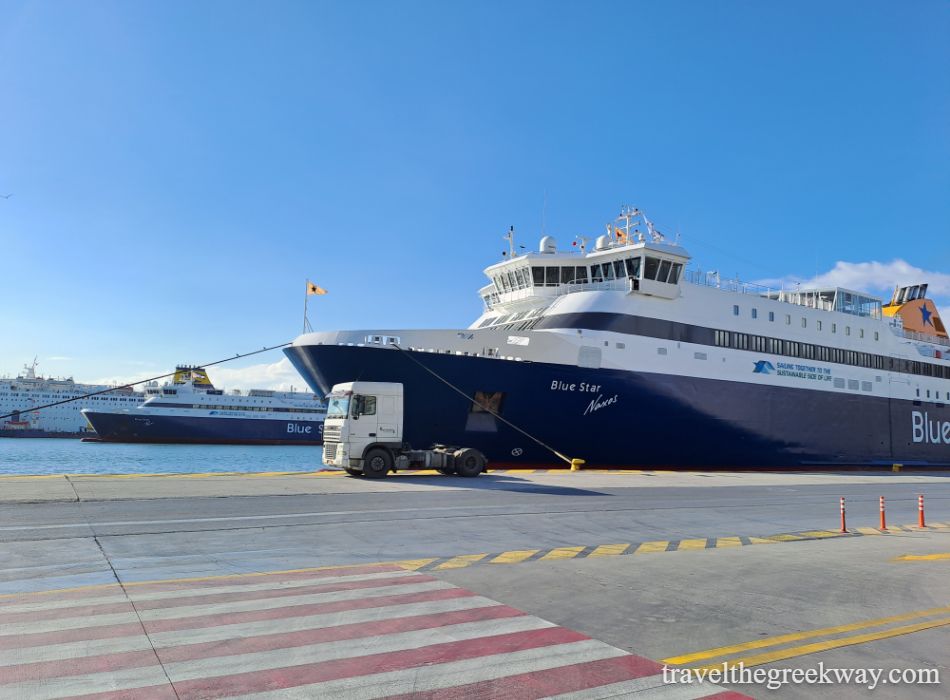
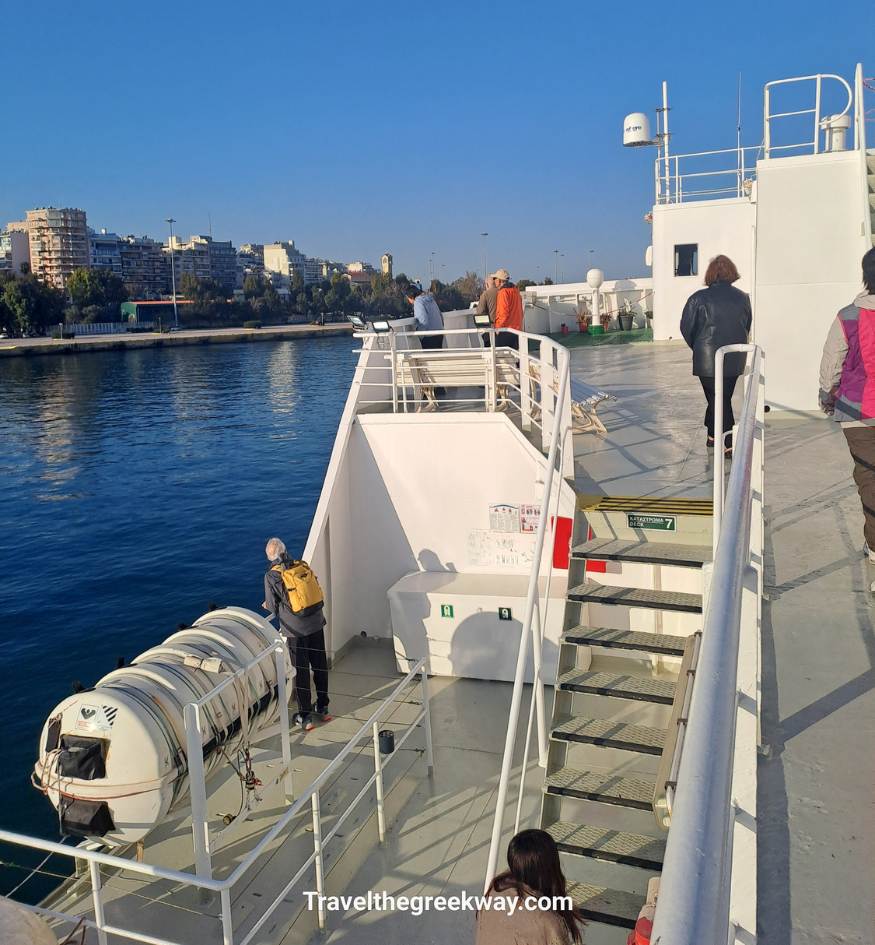
- Outside Decks: You can enjoy the sun and watch the “hustle and bustle” of every port.
- No Luggage Stress: Ferries don’t care if your bag weighs 20 kg (44 lbs) or 50 kg (110 lbs). You simply leave your bags in the designated racks on the main deck.
- Pets Welcome: Much more pet-friendly than regional planes, offering specific cabins or deck areas.
- Facilities: They carry cars, trucks and they have shops, cafes, and restaurants.
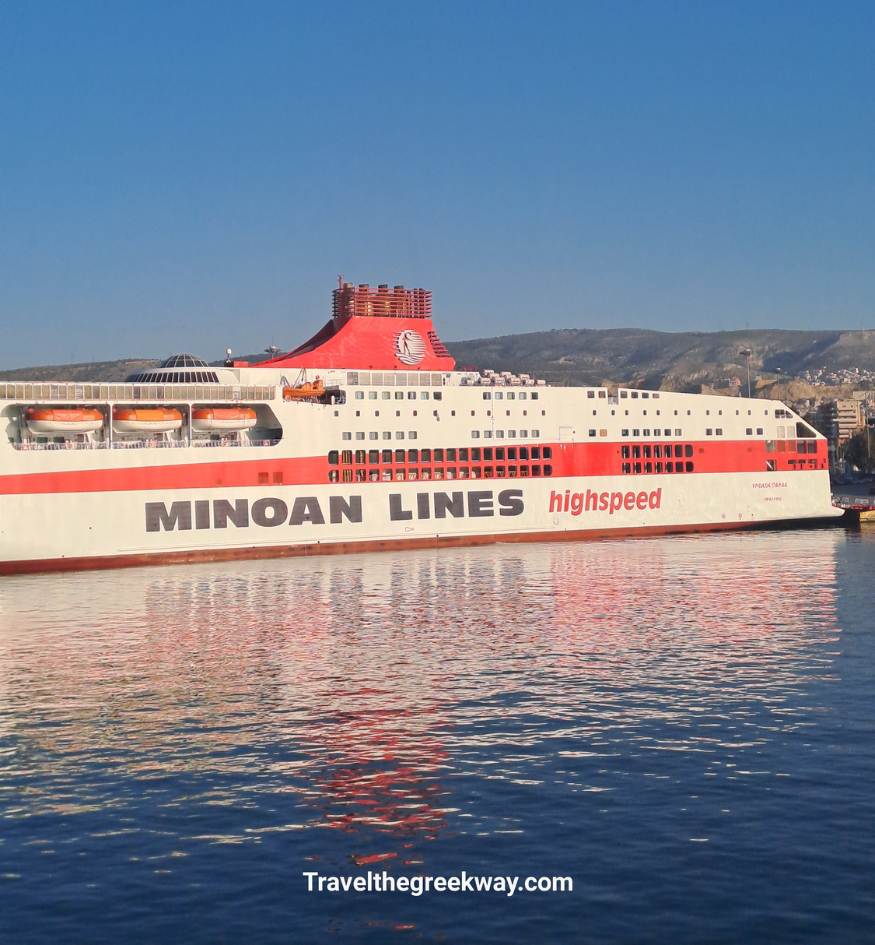
- The Cabin “Game-Changer”: You can book a cabin for morning runs. It provides a private “lounge” with a bathroom and shower—perfect for families or seniors.
- Accessibility: Most ships have specific Disabled Cabins (with wider doors and accessible bathrooms). These are limited, so you must book them well in advance by phone or through a specialized agent.
High-Speed Catamarans (SeaJets, Fast Ferries)
These are smaller and significantly faster, but they come with caveats:
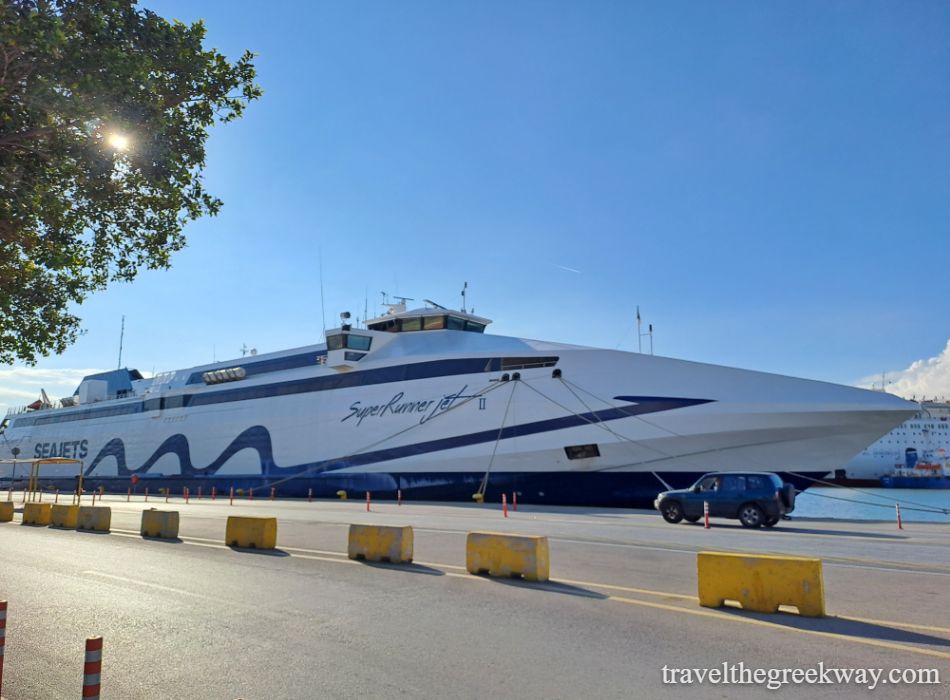
- The Price: Tickets are often double the price of conventional ferries.
- The Ride: They can be “bumpy” in choppy seas. If you suffer from seasickness, stick to the larger ships.
- Amenities: Mostly indoor seating with limited movement compared to the big ships. They do not take cars.
- Accessible to people with disabilities.
- Prone to delays/cancellations in high winds.
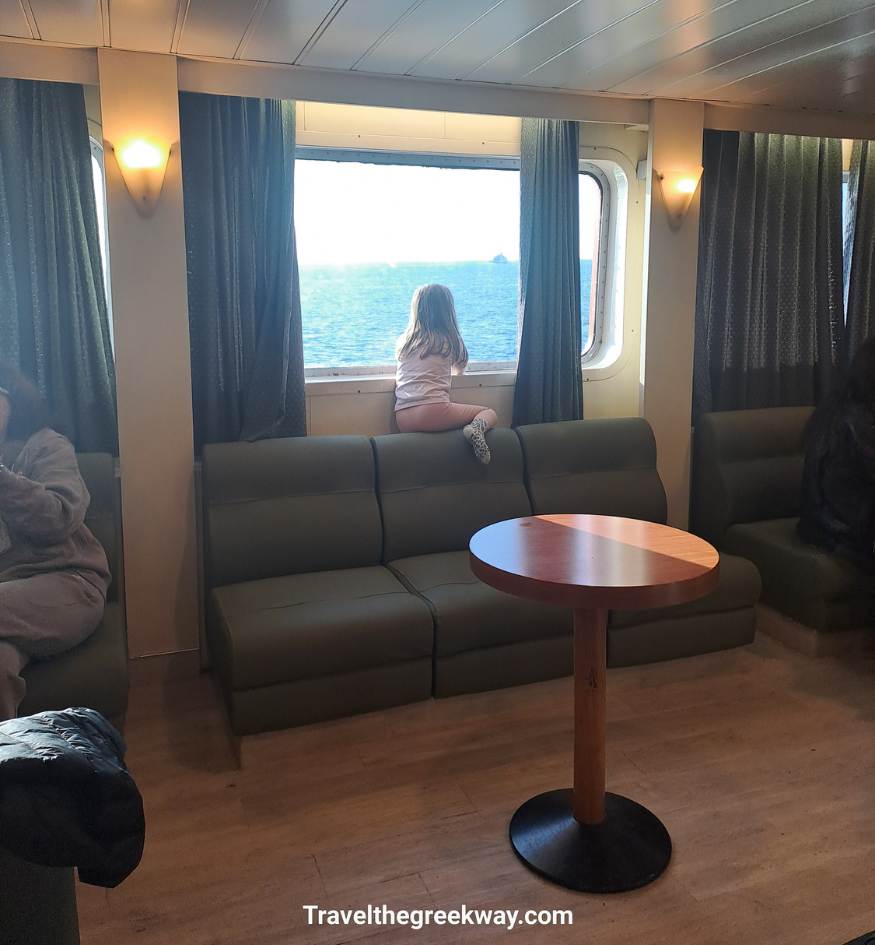
- Choose SeaJets if: You want to travel quickly between islands, are visiting popular Cyclades islands like Mykonos and Santorini, and don’t mind paying a little more for speed.
- Choose Blue Star Ferries if: You prefer a more leisurely, comfortable journey, are traveling with family, or are on a budget. Blue Star is ideal if you’re planning to visit a wider range of islands or if you value the ferry experience itself as part of the adventure. It can feel (almost) like you are on a cruise ship!
Roll-On/Roll-Off Ferries

Unlike larger cruise ferries, they are typically smaller, open-decked boats that provide the bare essentials for short transit.
Where will I find them? They serve as vital links for short distances and local connections, such as:
- Mainland to Island: Galatas to Poros or Mantoudi (Evia) to Skiathos.
- Intra-Island Links: Connecting Lixouri with Argostoli on Kefalonia.
What is the onboard experience?
- Stay in Your Car: On these short routes, you have the option to remain in your vehicle during the crossing.
- Open-Air Seating: If you prefer to stretch your legs, you can sit outside and enjoy the view.
- The ticket is usually around 10 or 12 euros.
2026 Price & Time Comparison
| Route | Slow Ferry (Price/Time) | Fast Ferry (Price/Time) |
| Piraeus – Mykonos | ~€48-€54 / 5h 15m | ~€85-€95 / 2h 45m |
| Piraeus – Santorini | ~€58-€62 / 7h 45m | ~€98-€115 / 4h 45m |
| Piraeus – Paros | ~€48-€52 / 4h 15m | ~€75-€85 / 2h 50m |
| Piraeus – Crete (Heraklion) | ~€48-€55 / 9h (Overnight) | ~€95-€110 / 6h (Seasonal) |
| Mykonos – Santorini | Not applicable | ~€85-€98 / 1h 55m |
Note: Prices of the ferry tickets do not change during the year.
Buying Ferry Tickets
If you plan to travel between June and September, I strongly recommend booking your seats in advance for both ways.
The Critical Window: Pay special attention to the dates from August 1st through the end of the month. This is when almost all of Greece is on vacation.
After the 15th, there is a massive wave of locals returning from the islands to the mainland. During this time, ferries and flights can be literally full to the last seat.
You can check the Ferryhopper site for availability and prices.
Note: Ferry companies begin releasing schedules early in the year, but the complete summer timetable and final prices are usually fully available and open for booking by March.
Logistics: Which Port Should You Use?
Now that you’ve picked your ship, you need to know where to find it. Athens has three main gateways.
1. The Main Gateway: Port of Piraeus
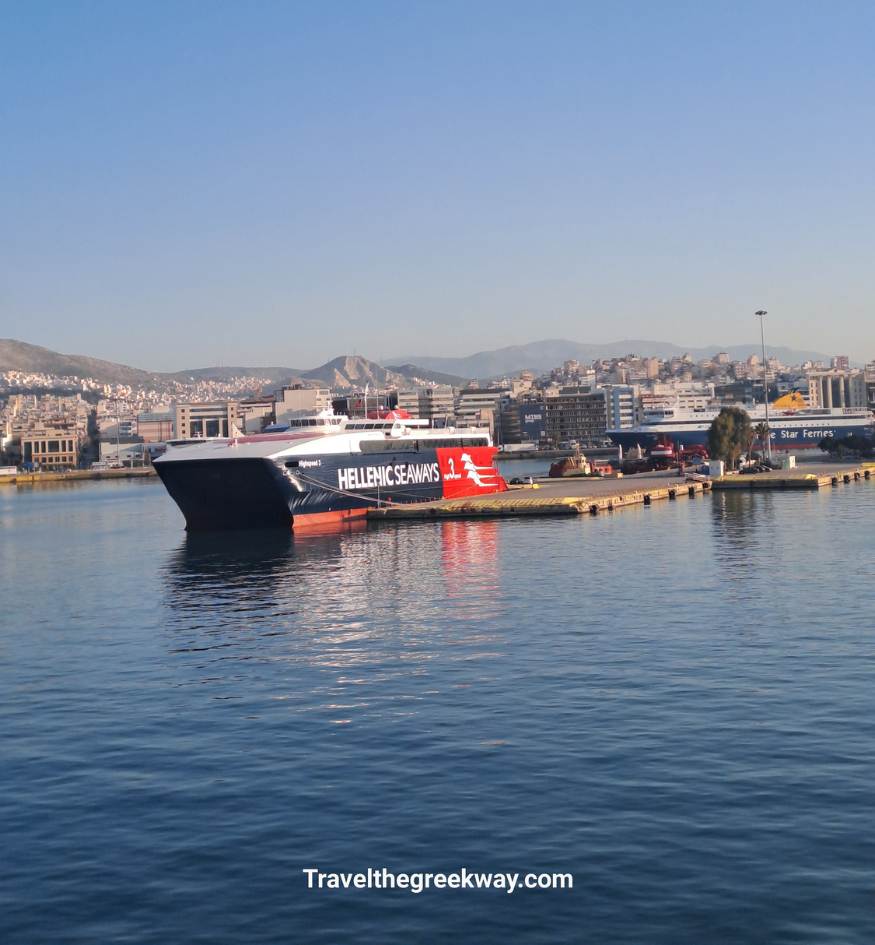
- Best For: Travelers staying in central Athens or Piraeus.
- The Logistics: From the Airport, it’s about 45 km (28 miles / 147,638 ft) away.
- Travel Time: 60-70 mins by Metro (Line 3) or 50-60 mins by taxi.
- Local Tip: Use the Free Shuttle Bus! The main stop is inside Gate E5, directly opposite the Metro Station. It saves a hot 20-minute walk with heavy bags.
- The Experience: It is chaotic, massive, and exciting. You’ll see every type of ship from tiny hydrofoils to massive cruise liners.
2. The “Airport Shortcut”: Port of Rafina
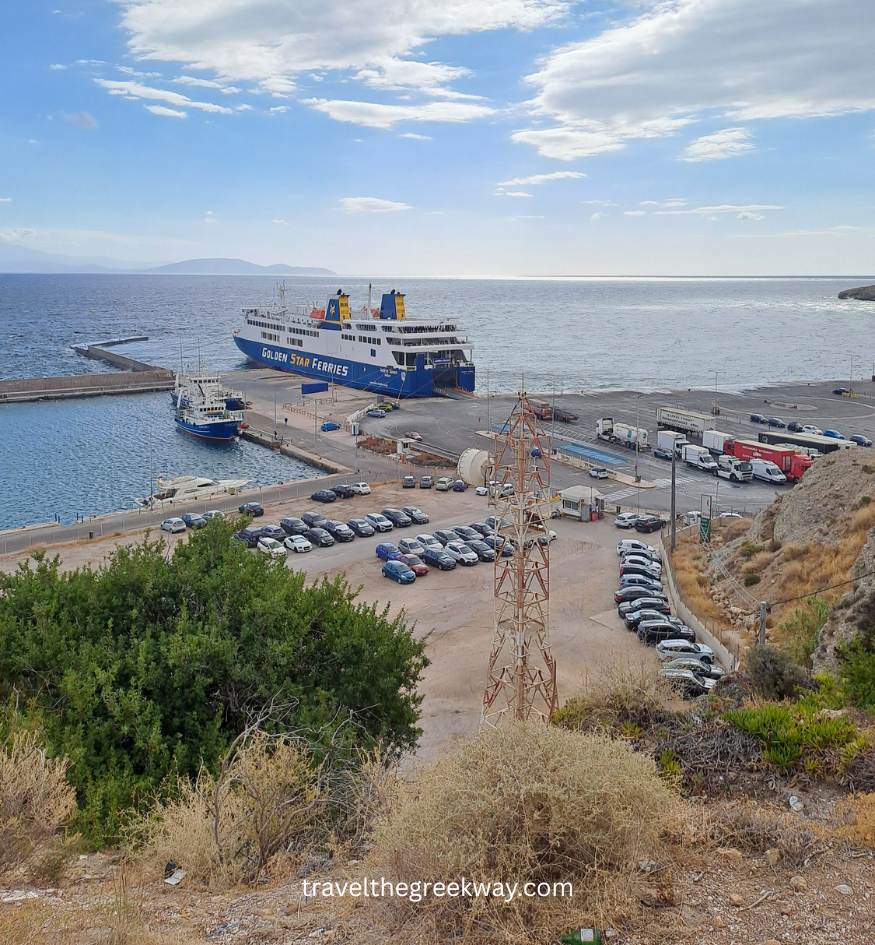
- Best For: Landing at the airport and wanting to get on a boat immediately.
- The Logistics: Only 20 km (12.4 miles / 65,617 ft) from the airport.
- Travel Time: Just 20-30 minutes by taxi or bus.
- Local Tip: If heading to Andros, Tinos, or Mykonos, Rafina is almost always faster and cheaper than Piraeus.
- The Experience: Much calmer than Piraeus. It’s a “local” favorite because you can grab a nice seafood lunch right by the water while waiting for your ferry.
- The best hotel in the area with free airport transfer is the Avra hotel.
3. The “Budget Secret”: Port of Lavrio
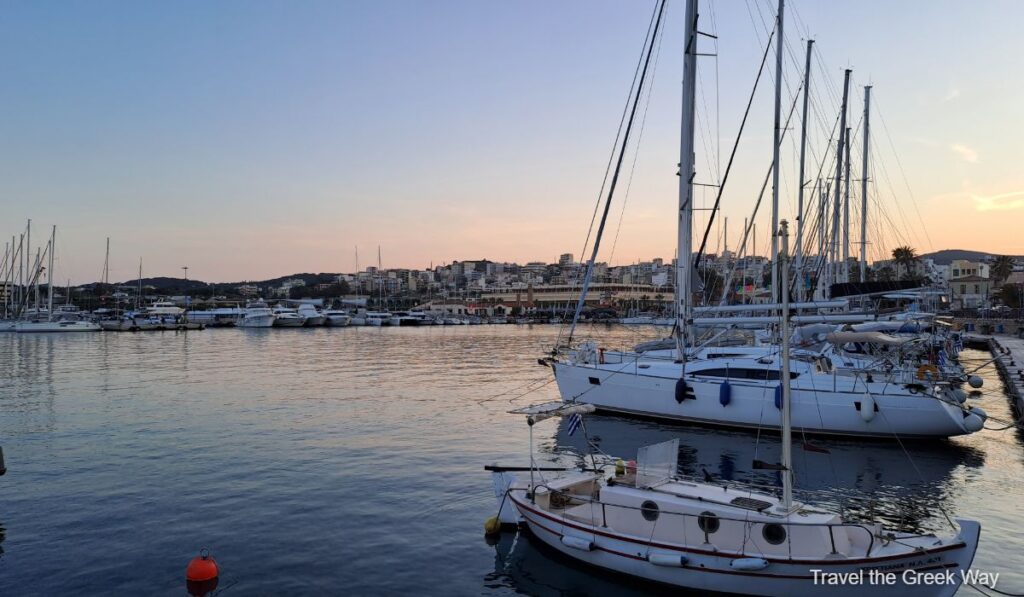
- Best For: Absolute lowest prices or heading to Kea (Tzia) or Kythnos.
- The Logistics: Lavrio is about 37 km (23 miles / 121,391 ft) from the airport.
- The Pro/Con: Tickets can be as low as €22, but the journey to your island can take 9-10 hours. Only choose this if you have a full day to spare!
Driving Your Car onto a Greek Ferry
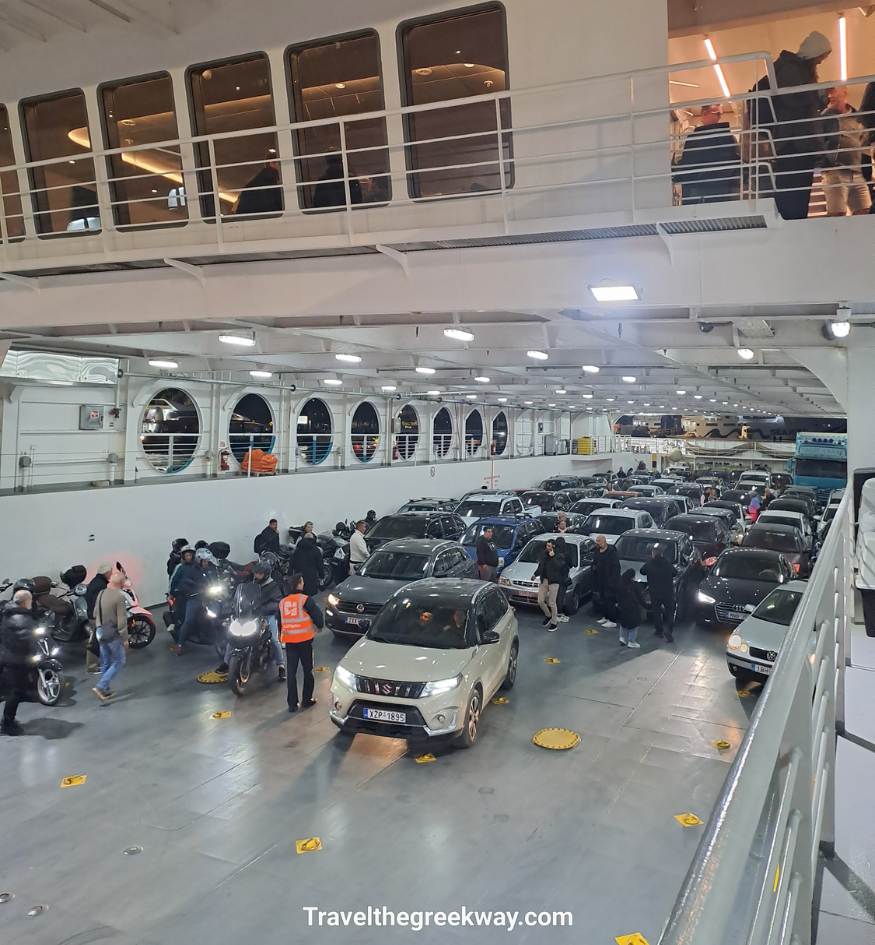
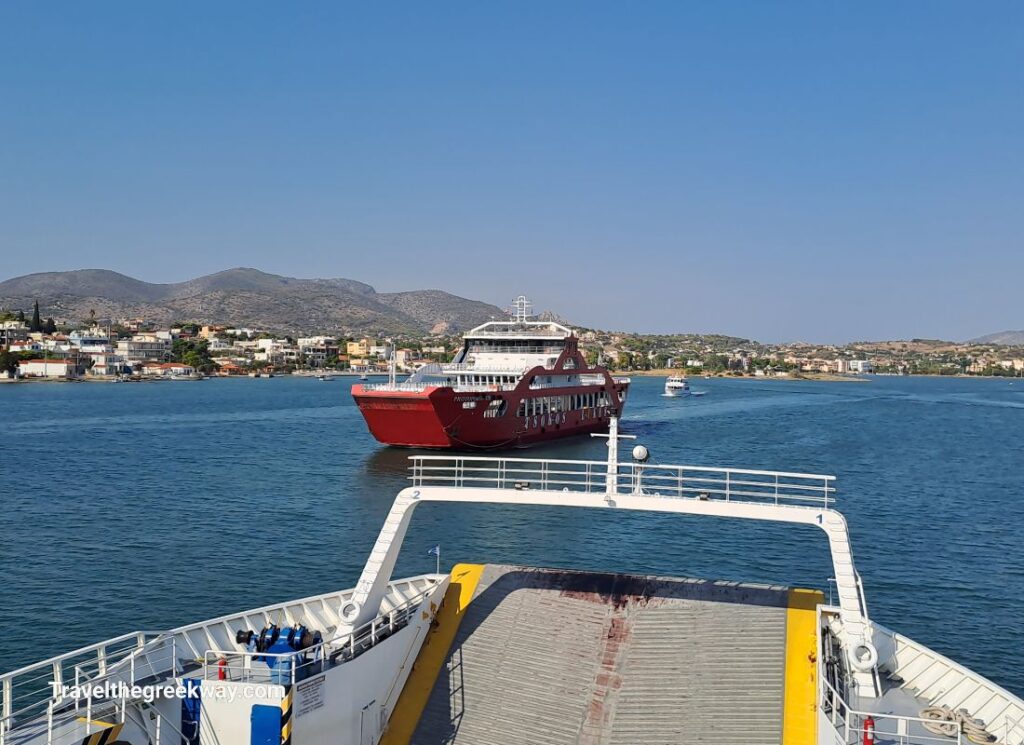
Is it difficult to park on the ferry? On large ferries (to Crete, Rhodes, or the Cyclades), you typically just drive forward and follow the crew’s hand signals.
On smaller boats, you may be asked to reverse into tight spaces. The crew will pack cars inches apart to maximize space—don’t panic, just follow their lead.
What is the best way to handle the stress of tight parking?
Trust the crew entirely and look only at them. They are experts at fitting cars into “impossible” gaps.
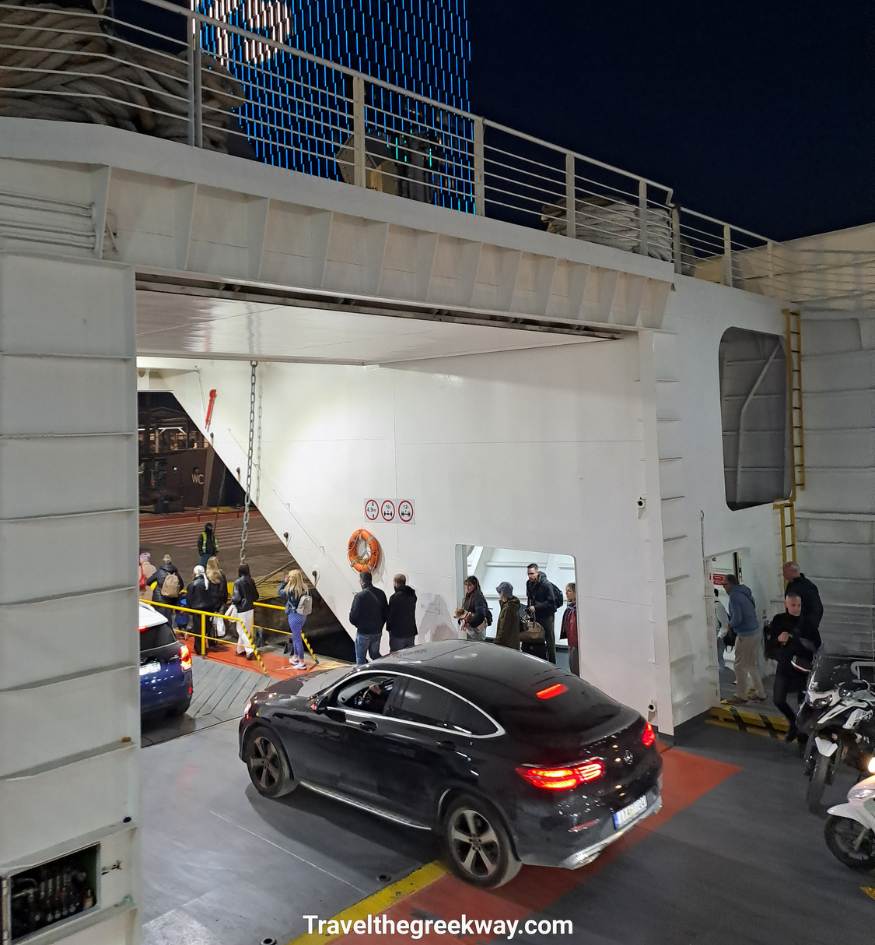
If you are too overwhelmed, you can simply hand your keys to a crew member at the garage entrance and ask them to park for you.
How should I leave my car once parked? To ensure the car doesn’t move during the voyage:
- Engage the handbrake firmly.
- Leave the car in first gear (or “Park” for automatics).
- Lock the doors and head upstairs.
Is driving off the ferry easier? Yes. While loading is precise and packed, driving off is a straightforward process once the ramp drops at your destination.
Option 2: Taking to the Skies
If you skip the sea, you’ll likely book with one of these three carriers.
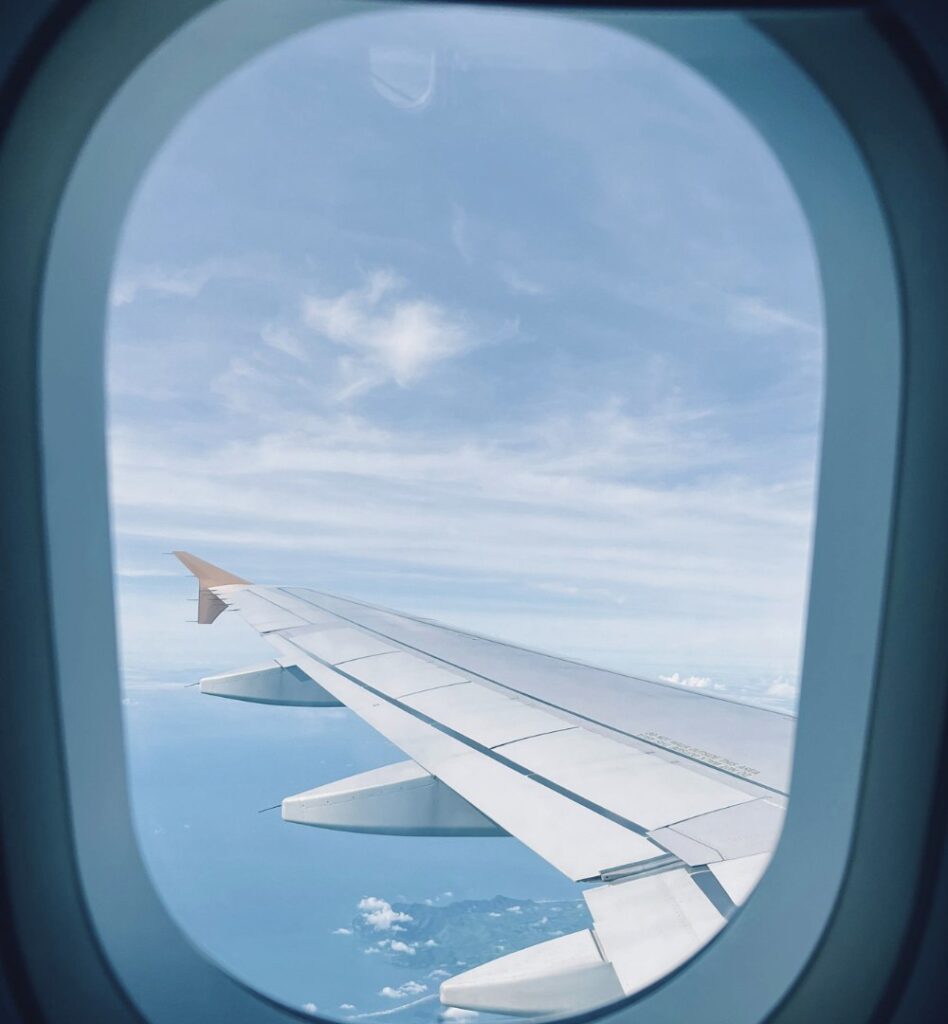
1. Aegean Airlines (The Premium Choice)
As the flagship carrier and a Star Alliance member, Aegean is the “Gold Standard” for Greek travel.
- Best For: Travelers seeking reliability, a modern Airbus fleet, and those who collect miles (United, Lufthansa, etc.).
- The Experience: Even on a short “hop,” you usually receive a small Greek snack and water. They offer the most frequent schedules, which is a lifesaver if your international flight is delayed.
Mastering the Luggage Limits
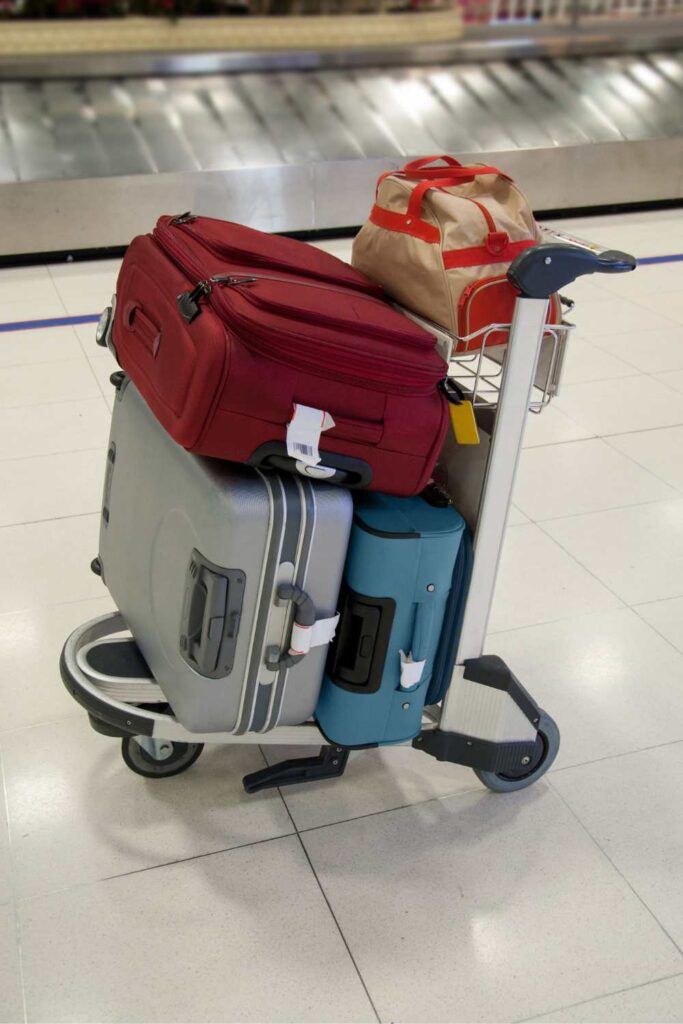
Aegean is quite strict with carry-on sizes, especially on their smaller regional planes. If your bag is even slightly over the limit, be prepared to gate-check it. Generally, there are three types of luggage to manage:
| Type | Max Dimensions | Max Weight |
| Checked Bag | Under 156 cm (61.4″ / 5.11 ft) total | 23 kg (50.7 lbs) |
| Carry-On | 55 x 40 x 23 cm (21.6 x 15.7 x 9.05″) | 8 kg (17.6 lbs) |
| Personal Item | Must fit under the seat (laptop/handbag) | No weight limit |
Local Hack: Put your heaviest items in your personal item! If your carry-on bag is wider than 23 cm (9.05″), it will likely be rejected by Aegean, and you’ll have to pay an extra €60 per bag.
The Ideal Size: For a stress-free trip, look for a bag around 22.6 cm(8.9 inches) wide, like this Luggage Airline Approved.
2. Olympic Air (The Regional Specialist)
Owned by Aegean, Olympic uses smaller turboprop planes specifically for islands with short runways like Naxos, Milos, and Paros.
- Best For: Reaching islands where big jets can’t land.
- The Experience: These planes are loud and sturdy, but seats are limited (40–70 per flight). Book early! If you see a seat for €60–€80, grab it before it hits €150+.
3. SKY Express (The Modern Challenger)
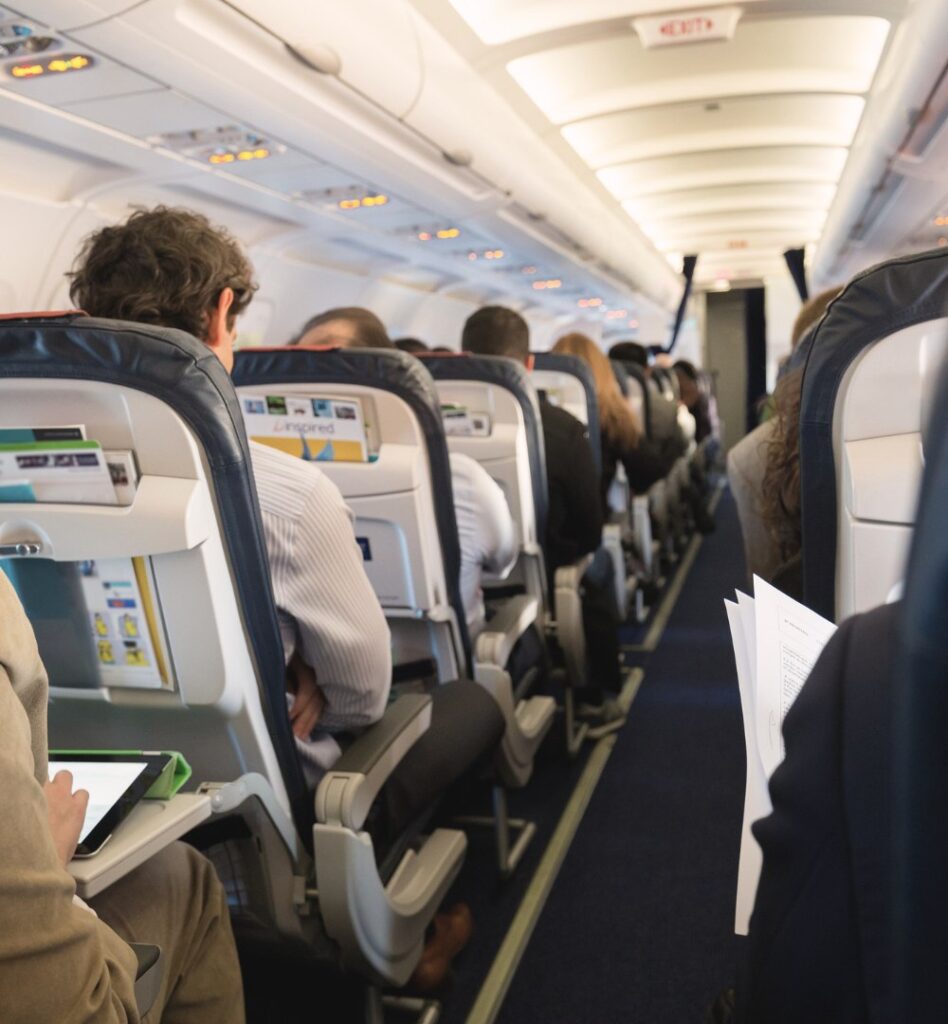
The fastest-growing airline in Greece, SKY Express, offers a modern fleet and very competitive pricing. They are the main rival to Aegean/Olympic.
- Best For: Budget-conscious travelers who still want a “premium” feel.
- The Experience: On major routes (like Athens to Santorini or Crete), they often fly brand-new Airbus A320neo planes.
- The Perk: Their “Sky Joy” and “Sky Enjoy” fares often include a “light” checked bag or more flexible changes, where other airlines might charge extra. Always double-check the fare class!
Luggage at a Glance:
- Checked Bag: Up to 23 kg (50.7 lbs) and under 156 cm (61.4 inches) total.
- Carry-On: 55 cm x 40 cm x 23 cm (21.6″ x 15.7″ x 9″). Max 8 kg (17.6 lbs).
- Personal Item: Must fit under the seat.
Local Verdict: If the price is the same, I usually check which airline has the better departure time for my schedule.
Final Verdict: The “Hybrid” Strategy
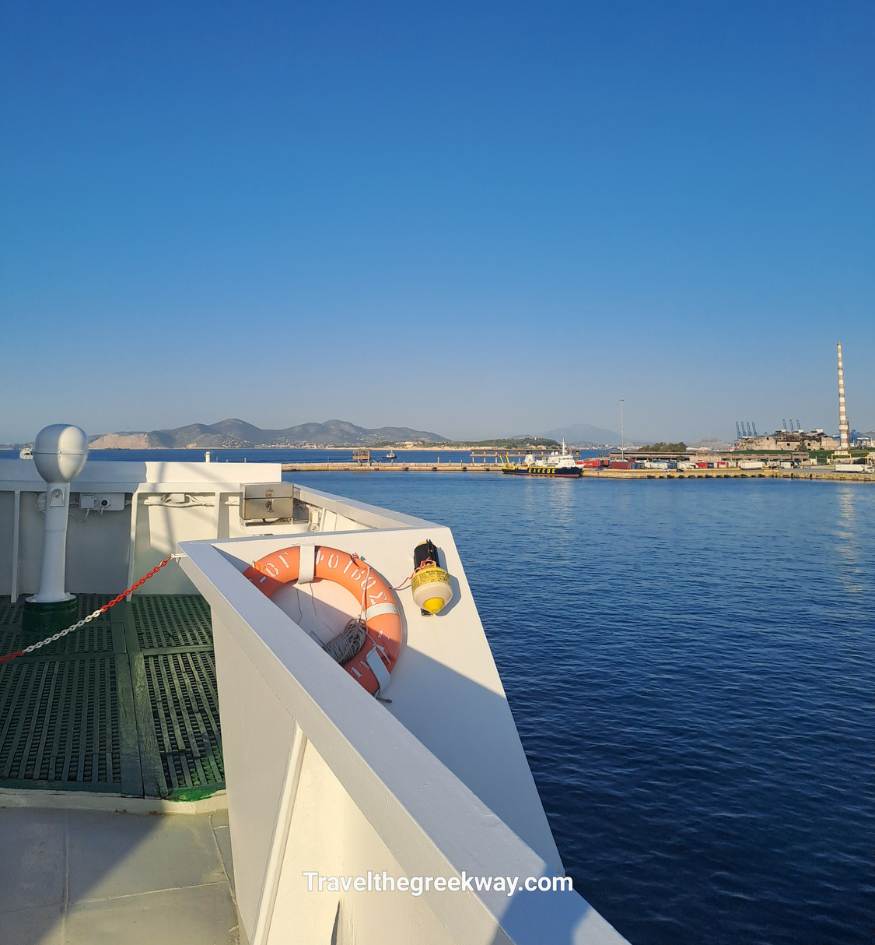
Why choose one when you can do both?
- Fly OUT: If you arrive in Athens from abroad, book a connecting flight immediately. You’re already at the airport—don’t waste 90 minutes getting to the port.
- Ferry BACK: Take the ferry at the end of your trip. It’s a relaxing goodbye to the islands and avoids the stress of small-plane luggage limits.
Crucial Advice: Never take a ferry on the same day as your international flight home. Industrial strikes (Apergia) or bad weather happen. Always spend your final night(s) in Athens to be safe.
The Traveler’s Safety Net: Handling Ferry Strikes/ Delays
While Greek ferries are generally very reliable, you must be aware of Apergia (the Greek word for strike). In Greece, transportation strikes are a part of life and are usually announced with 24 to 48 hours’ notice.
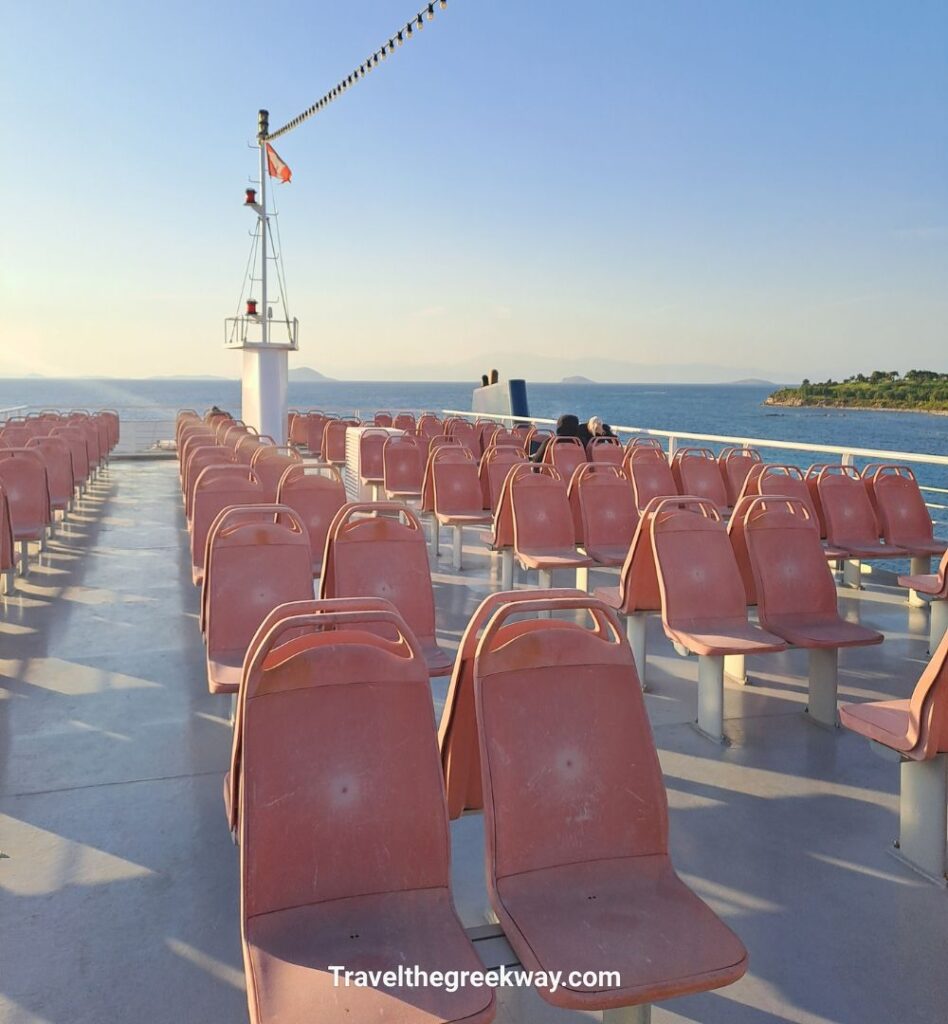
What happens during a strike? If the Panhellenic Seamen’s Federation (PNO) calls a strike, all ships stay in port. No Blue Star, no SeaJets, no exceptions. This can leave you stranded on an island or stuck in Piraeus.
How to protect your trip:
- Monitor the News: Use a site like Apergia.gr or check the “Strike Dashboard” on major Greek travel blogs about 48 hours before you travel.
- The SMS Alert: If you booked your tickets online (via Blue Star, Ferryhopper, etc.), they will almost always send you an SMS or email the moment a strike is officially confirmed. Make sure the phone number on your booking is one you actually check while traveling!
- Refunds & Changes: If your ferry is canceled due to a strike, you are legally entitled to a full refund or a free change to the next available sailing.
- Follow your ferry route in this live Greek ferry map tracker.
Local Insider Tip: If a strike is announced for your travel day, don’t wait for the official cancellation email.
Go to a local travel agency at the port immediately. They can often rebook you on a ferry for the day before the strike starts, which is the smartest way to avoid getting stuck.
My Personal Preference
I always fly to the more distant islands like the Dodecanese or the Northern Aegean (Rhodes, Kos, Lesvos, Crete), but take the slow ferry for the Cyclades or Ionian as I love driving there through the mainland.

Where to Stay in Piraeus Near the Ferries?
Athenarum Portus Life & Style Hotel is a beautiful hotel, 1-minute from the train station, across from Piraeus port.
Other fantastic options are Phidias Piraeus Hotel (by Mikrolimano bay) and Gallery Suites & Residences Piraeus with a lovely veranda and spa facilities.
The 2026 Ferry & Plane FAQs
What are the cabins like on the newer ferries?
Most modern ferries (like the Blue Star or Minoan Lines) have very comfortable cabins.
They typically offer double (2-berth) and four-bed (4-berth) options, with some ships offering three-bed cabins. Every cabin includes a private bathroom with a shower.
Are all cabins the same?
Definitely not. When booking, look for First Class or Lux (Luxury) cabins.
Avoid “Second Class” cabins if possible:
On older vessels, these can sometimes be located below the car garage.
These lower-deck cabins can be noisy and, in some cases, may smell of exhaust fumes. Stick to the upper decks for the best experience!
Wait, can a stranger stay in my cabin?
Yes. If you book a single “berth” (bed) in a 4-berth cabin without booking the entire room, the ferry company can sell the remaining beds to other travelers of the same sex.
The Local Hack for Privacy: To keep the cabin private, savvy travelers simply book all four beds. To save money, buy the three adult tickets you need and purchase a half-price child ticket for the fourth berth. This guarantees a private sanctuary for just a few extra Euros.
The best way to book
While there are many websites out there, I always tell my friends and family to use Ferryhopper. Why it’s the best of the bunch:
Easiest to Use: Their app and website are incredibly intuitive. You can see all the different ferry companies (SeaJets, Blue Star, etc.) in one place and compare times and prices instantly.
Problem-Solvers: This is where they truly shine. If there is a strike, a delay, or you need to change your plans, their customer support is prompt and effective.
The “Ghosting” Reality: With other booking sites, you might send an email and get a reply six months after your trip is over. Ferryhopper actually answers you when you need them—not when your vacation is a distant memory.
Do I need printed tickets, or can I use my phone?
You can use your phone. However, if it is easy for you, print a copy just in case there is something wrong with your internet connection.
Where should I store my bags on ferries?
With a Cabin: Keep all luggage locked inside with you.
With a Seat: Keep valuables with you. Place large bags in the racks by the garage entrance. On high-speed boats (like Seajets), it’s often easier to keep bags at your seat for a faster exit.
Is my luggage safe in the racks? Yes, the passenger areas are generally self-policing. However, bags often get shifted or buried by others boarding later. As I get very stressed about someone accidentally (or not!) picking up my suitcase, I always just bring my bags up to my seat.
When should I head to the garage for arrival? Go as soon as the port is announced. This gives you time to find your bags if they’ve been moved and join the line to disembark.
Can I take a rental car or scooter on the ferry?
Yes, you can, but you should compare the cost of the ferry ticket for the car against the price of renting one on the island. Generally speaking, if you plan to stay for more than 5 days, it makes sense to bring your own car.
If you are only visiting for a few days, it is better to rent locally.
Will I find food on board?
Yes, but the options depend on the type of vessel:
Large Ferries: Most feature full-service restaurants, self-service cafeterias, and bars. You’ll find everything from full meals to snacks and coffee.
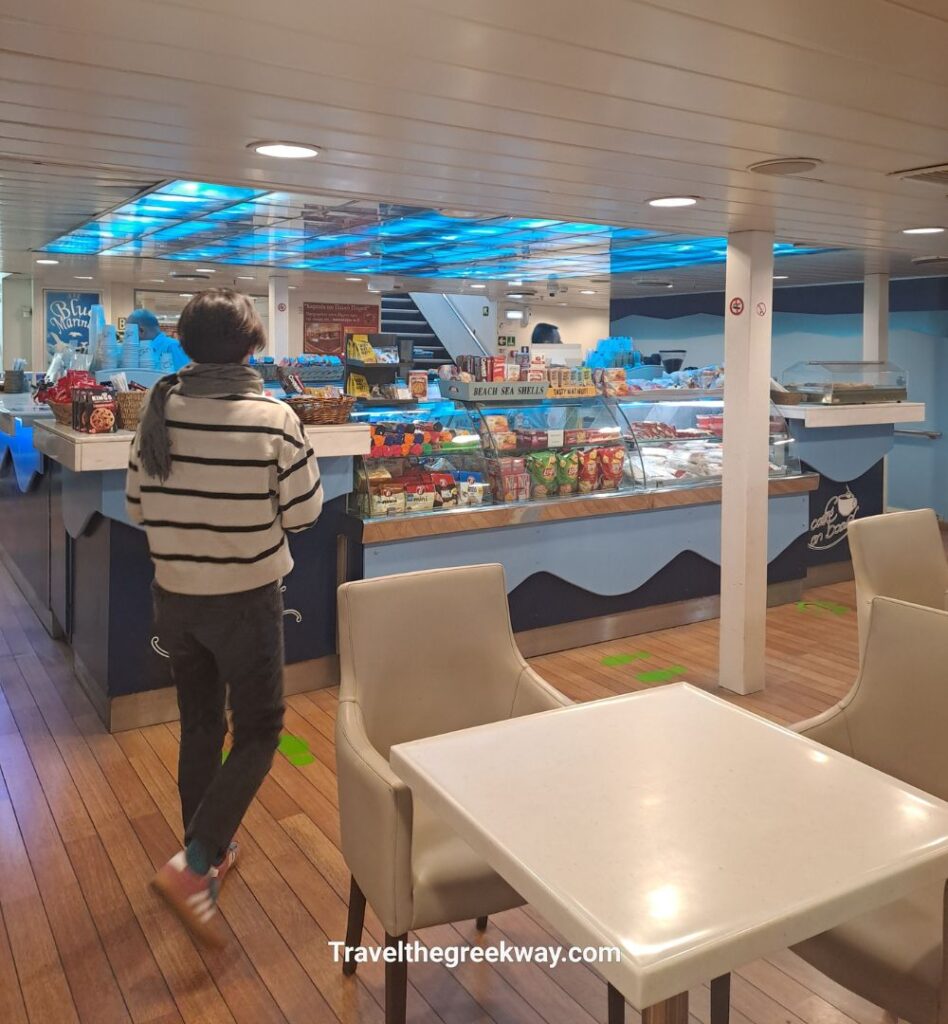
High-Speed/Seajets: These typically have a snack bar or cafe serving sandwiches, pastries, and drinks.
Do I have a specific seat?
It depends on the boat! On high-speed ferries (like Seajets), yes—your ticket will have a specific seat number.
On the big conventional ferries, it’s a bit more relaxed. If you have an economy ticket, it’s usually first-come, first-served in the lounge or on the deck.
If you book a “Numbered Seat” or “Business Class,” you’ll have a spot reserved just for you.
What should I bring with me on the ferry?
A Light Layer (The “Arctic” AC): Even in 40°C heat, ferry interiors are often blasted with air conditioning. A hoodie, light jacket, or large scarf is a lifesaver.
Power Bank & Long Cable: Sockets are limited and often tucked in high or awkward corners. Don’t rely on finding an open one.
Seasickness Meds: The Aegean can get choppy, especially in July and August (the Meltemi winds). Bring ginger tablets or motion sickness pills just in case.
Offline Entertainment: Data connection is spotty at best once you’re in open water. Download your movies, podcasts, or maps before you board.
Sunscreen & Hat: If you plan on sitting on the deck to enjoy the view, the Greek sun—combined with the sea reflection and wind—will burn you faster than you realize.
Hand Sanitizer & Tissues: High-traffic restrooms can run out of soap or paper toward the end of a long journey.
Noise-Canceling Headphones: Essential if you’re hoping to nap in the lounge areas, which can get noisy with announcements and crowds.
Pro Tip: The “Ferry Footwear”
Wear non-slip shoes. The ramps and floors can be slippery, especially if they are wet from sea spray or cleaning. Flip-flops are great for the beach, but sturdy sandals or sneakers are safer for navigating the stairs and garage.
Are small island planes different from normal flights?
Yes. To reach islands with short runways, airlines like Olympic Air or SKY Express use turboprop planes. These are smaller and fly at lower altitudes, offering incredible views.
However, overhead bins are tiny. If your carry-on is a standard “roller” bag, it will likely be gate-checked (taken at the plane steps and returned to you on the tarmac at your destination).
What are the luggage rules for domestic Greek flights?
Strict Weight Limits: Most “Light” or “Joy” fares only allow a 23 lb (8 kg) carry-on.
The “Personal Item” Rule: You can also bring one small personal item (like a backpack or purse) that must fit under the seat.
Checked Bags: If your bag exceeds 50 lbs (23 kg) on a standard fare, be prepared for steep overweight fees at the counter.
How early should I arrive at the airport?
For domestic flights from Athens, arrive 90 minutes before departure. At small island airports, 60 minutes is usually plenty.
Warning: At Athens (ATH), gates close strictly 15 minutes before takeoff—if you aren’t there, they will reassign your seat.
What happens if my flight is delayed or cancelled?
In Greece, “Meltemi” winds can sometimes ground small planes. If your flight is cancelled, the airline must offer you a rebooking or a full refund.
Pro Tip: If your flight is delayed by over 3 hours (and it isn’t due to weather), you may be entitled to compensation under EU law (Regulation 261), which for short island hops is typically €250.
Are there liquid restrictions on domestic flights?
Yes, the rules are the same as international flights. All liquids must be in containers of 100ml (3.4 oz) or less, and all must fit into a single, transparent, one-liter resealable bag.
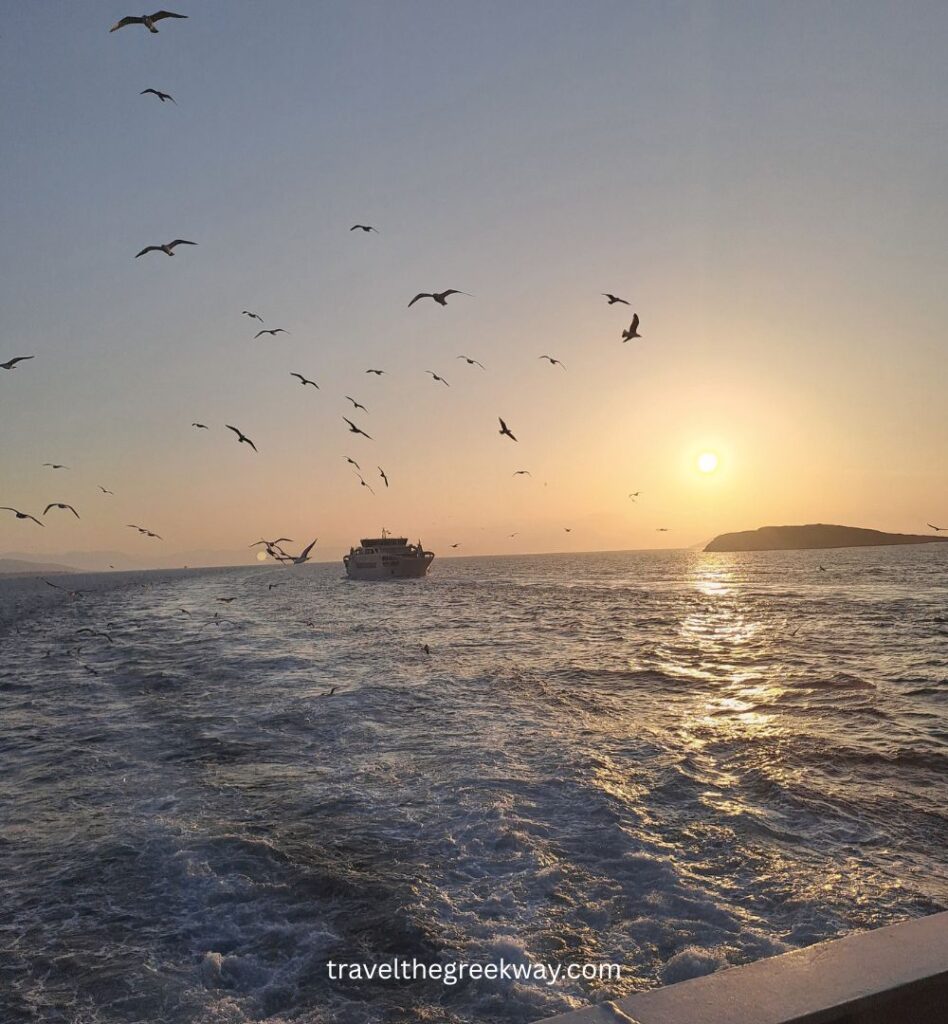
The ferry isn’t just a commute; it’s the heartbeat of the Greek summer. My advice? Lean into the “go with the flow” energy.
If you bring a little patience and an open heart, the Aegean rewards you. I’ve found lifelong friends and shared songs with strangers on those decks—moments you just won’t find at 30,000 feet. While a plane gets you there, the ferry is where you actually find the spirit of Greece.
The Saronic Side-Trip from Athens
If you have a few extra days in Athens, don’t miss the Saronic Gulf islands. They are the closest to the city—some only an hour away—making them perfect for a quick escape without the long travel times of the Cyclades.
- Aegina: Famous for its world-class pistachios and the stunning Temple of Aphaia.
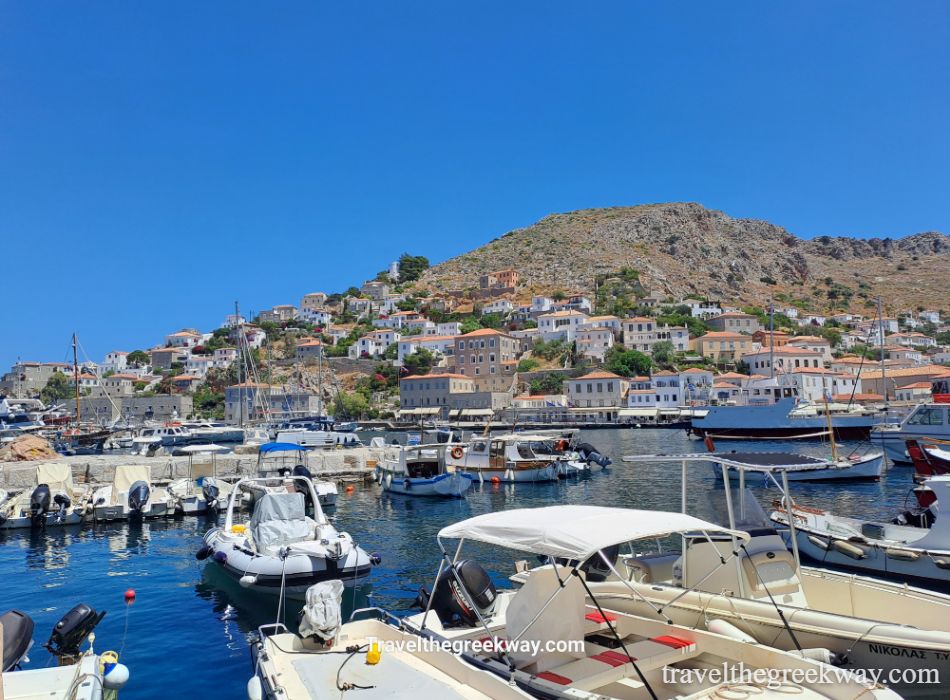
- Hydra: A car-free paradise where transport is on foot or boat, and the stone mansions feel like a movie set.
- Agistri: A tiny, pine-covered gem with neon-blue water, ideal for a quiet swim.
- Poros & Spetses: Cosmopolitan, lush, and filled with great waterfront dining.
Whether you take the “One-Day Cruise” to hit three islands at once or slow down for an overnight stay, the Saronics are the easiest way to get your final “island fix” before heading home.
Native Tip for Logistics: To avoid the massive mistake of trying to cross incompatible island groups, use my master [Greek island hopping guide] to choose one of the 7 main island clusters and lock in your daily itinerary.
Watch My YouTube Video on Poros Island
Plan Your Next Adventure in Greece
- ‘Hello’ and ‘Thank You’ in Greek: “Ya sou” and “Efharisto”
- Booking.com: I use Booking.com mostly for Europe.
- All-Inclusive Resorts in Greece
- Rent an Affordable Car in Greece
- Athens Metro Website (timetables and ticket info)
- Trains (Hellenic Train)
- Public Buses KTEL
- Get Your Guide: For all your day or multi-day tours and city guide needs, I use Get Your Guide
- Emergency Numbers Anywhere in Greece: AMBULANCE 166 – FIRE 199 – POLICE 100– EMERGENCY NUMBER 112
