Mycenae, located in the Peloponnese region of Greece, is one of the country’s most important UNESCO World Heritage Sites and a must-visit archaeological landmark.
Once a powerful financial and administrative center of the Mycenaean civilization (c. 1650–1100 BC), Mycenae played a key role in shaping ancient Greek culture and world history.
The site preserves the remains of a heavily fortified prehistoric palace, monumental gates, and impressive vaulted royal tombs.
Mycenae famously inspired Homer, who described it as “Golden Mycenae” in The Iliad, referencing the extraordinary gold treasures uncovered during archaeological excavations.
Today, you can explore two main areas visitors in the archaeological site of Mycenae:
The iconic Treasury of Atreus, a massive tholos tomb with towering stone lintels and a beehive-shaped vault, and the citadel, home to the Lion Gate, palace ruins, grave circles, and the on-site museum.
To see Mycenae from ground level, you can also watch my YouTube video, which captures a peaceful walk through the ruins and monuments of the site.
This post includes links that may be affiliate links. If you choose to make a purchase through them, I may earn a small commission at no extra cost to you. Please see my disclaimer/privacy policy for more information.
The Mycenaean Civilization
The Kingdom of Mycenae

The Mycenaean Palace was built on two remote steep hills in Argolis, Peloponnese.
The king and his family used to live inside the fortified walls of a palace with a militaristic infrastructure of genius architecture.
Around the walls, there were small settlements and estates with agricultural characteristics. When there was any outside danger, everyone would go inside the walled palace for protection.
Mycenaeans‘ economy was based on agriculture, animal husbandry, the ivory industry, stoneworking, and metallurgy.
However, the greatness of the Mycenaean world was mainly due to the development of shipping and trade. One important port was Asini, near Nafplio.
From the mid-15th century BC, the Mycenaeans, as historians claim, conquered Knossos in Crete. The Greek Mycenaean element gradually dominated the sea and spread to the Mediterranean.

The most important source for the cultural geography of the Mycenaean world is the archaeological finds and the Linear B texts.
Lion Gate Mycenae
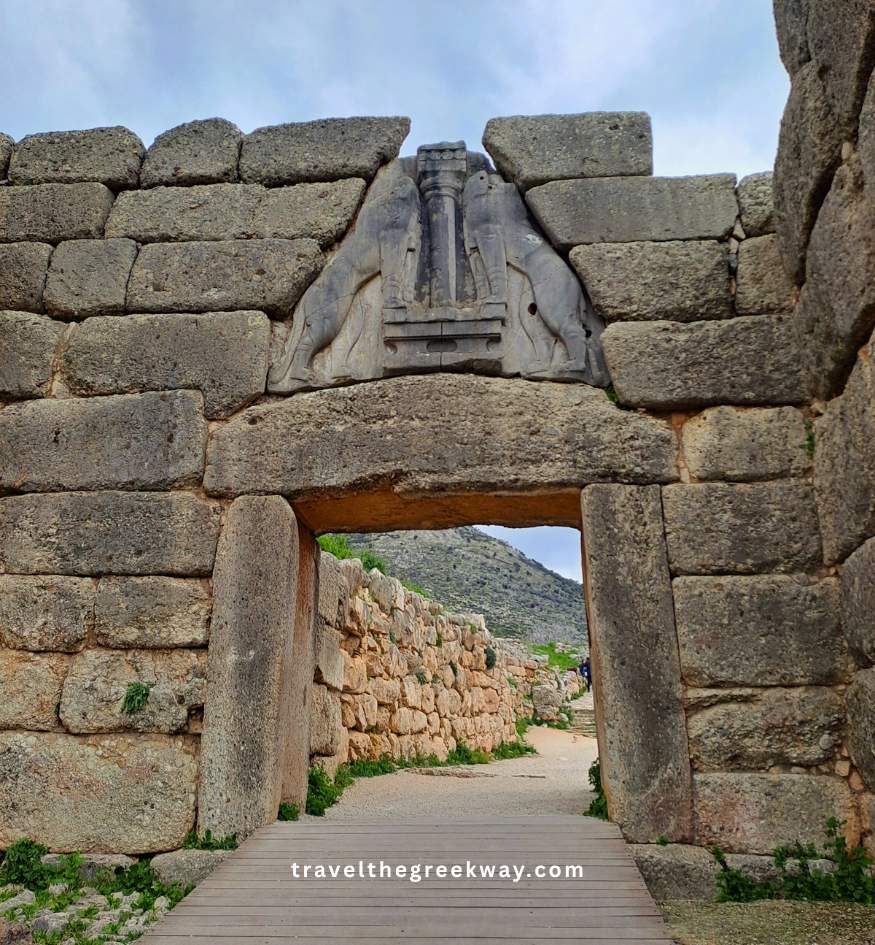
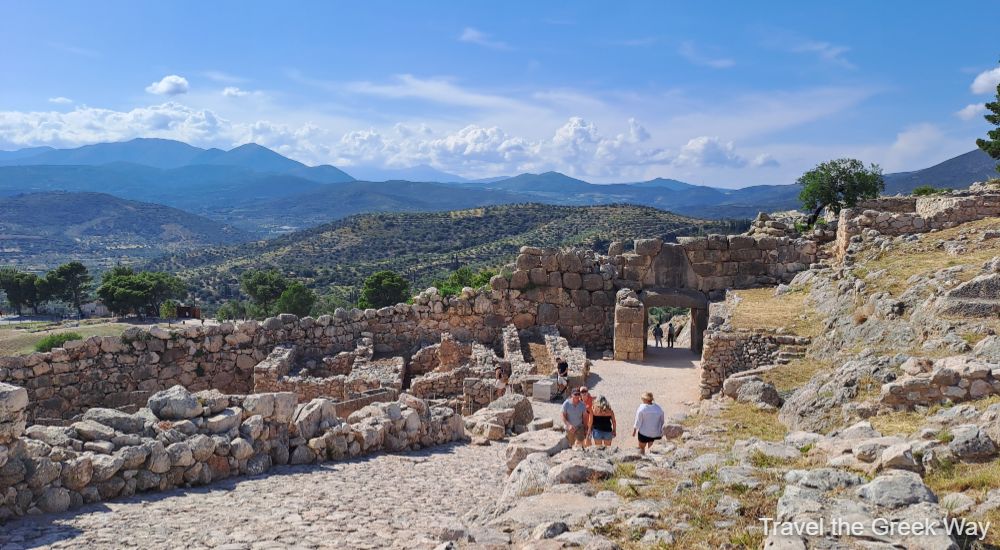
As soon as you pass by the ticket kiosk, the paved area will lead you to the monumental entrance to the Citadel of Mycenae.
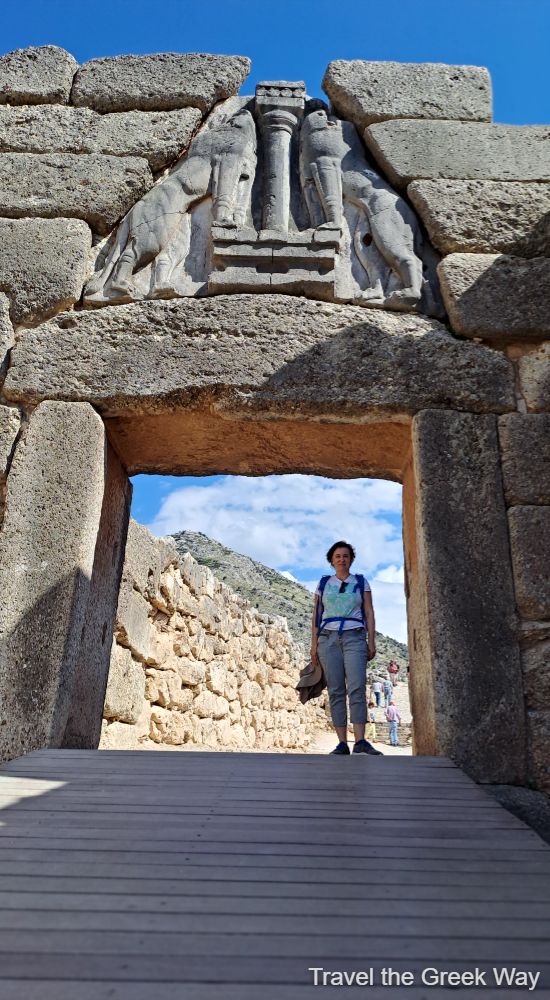
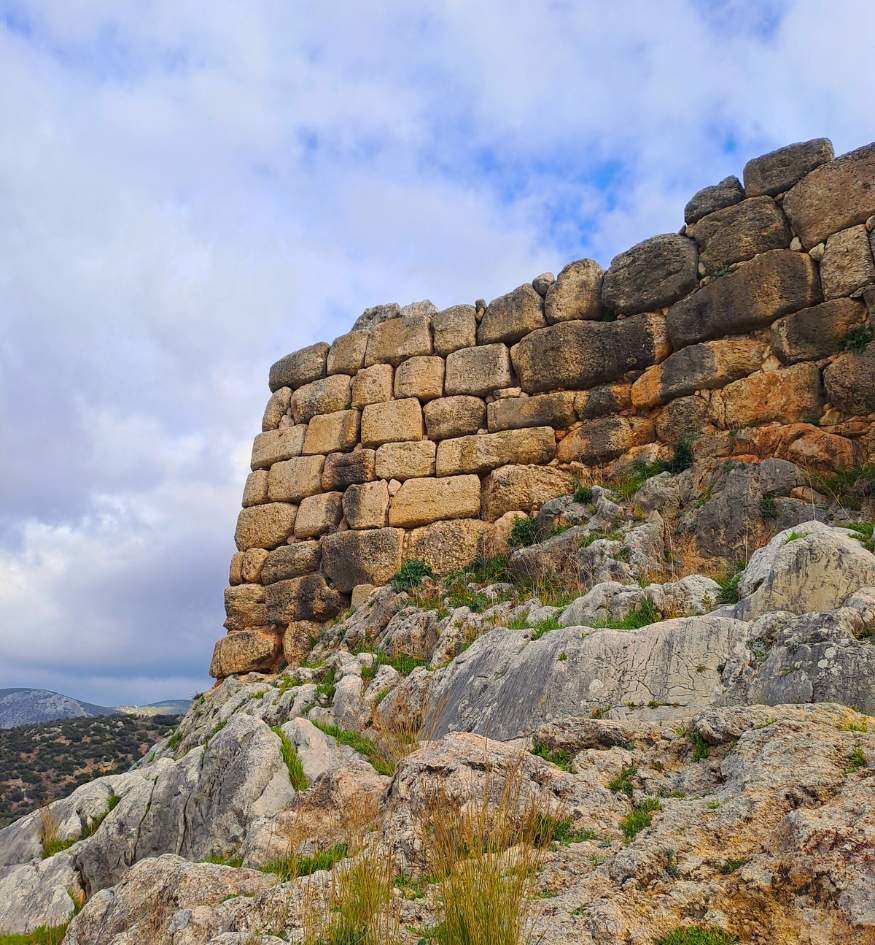
The walls leading to Lion Gate are made of enormous blocks of stone known as Cyclopean Masonry. Above the lintel of the Gate, there is a large triangular relief containing two headless animals with leonine bodies.
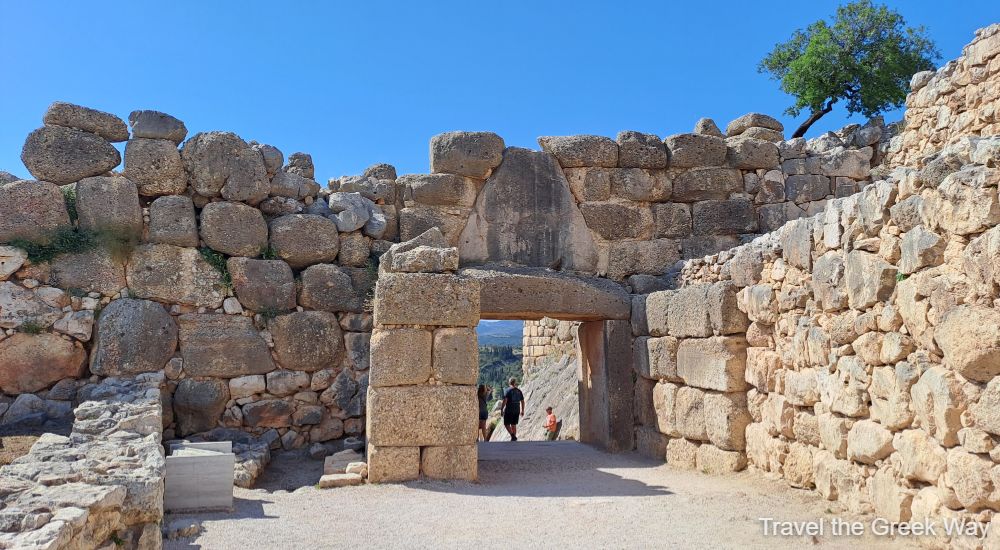
The Gate (built c.1249 BC) could be closed by a double, heavy wooden door that was secured by a sliding bar. The Lion Gate is the first monumental sculpture in Greece.
Grave Circles
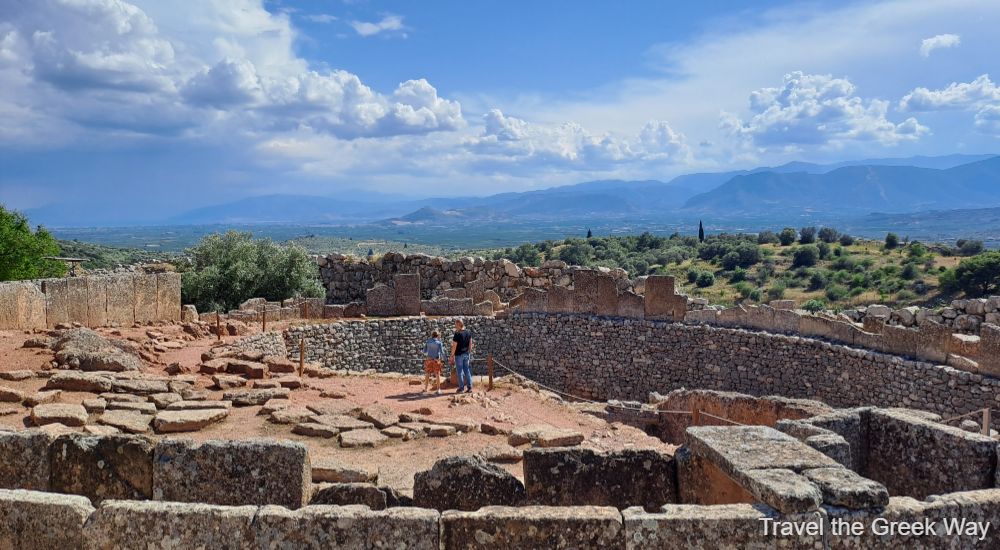
A striking feature of the Archaeological site of Mycenae is the Grave Circles A and B, which are the location of the royal burials.
Grave Circle A is located immediately to the right inside the Lion Gate and contains six shaft graves.
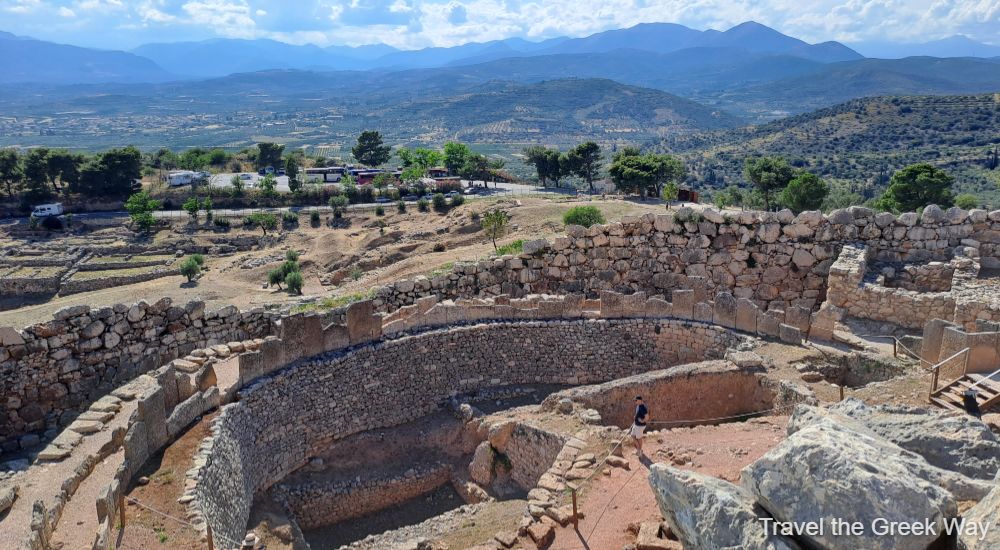
Inside the graves, the archaeologists found 19 skeletons, spectacular burial items, golden face masks, and items that belonged to the deceased.
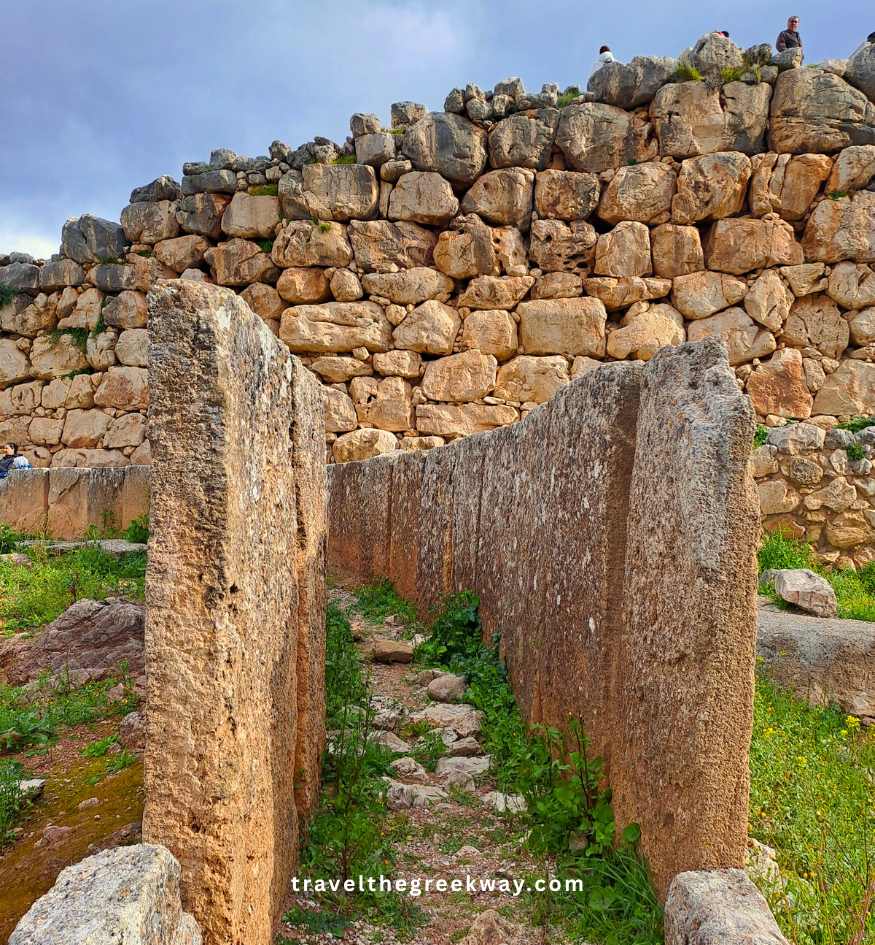
The most famous find is the mask discovered by Schliemann in the summer of 1876 while digging in Grave Circle A.
It was one of seven death masks discovered in the same grave circle, alongside an enormous cache of gold artifacts.
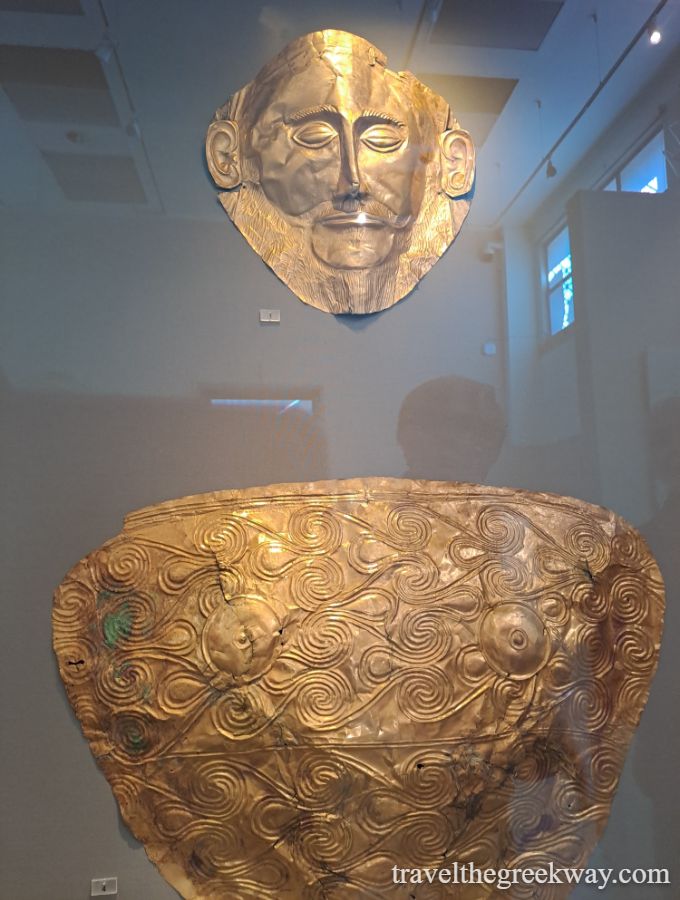
The hammered gold mask became the most iconic symbol of Mycenaean culture. The mask’s regal appearance led to its association with Agamemnon.
However, modern archaeological research has tentatively dated the mask to the second half of the 16th century BCE, at least 300 years before the Trojan War of the Iliad.
The mask is currently displayed in the Mycenaean Gallery (room 4) of the National Archaeological Museum in Athens.
The Palace
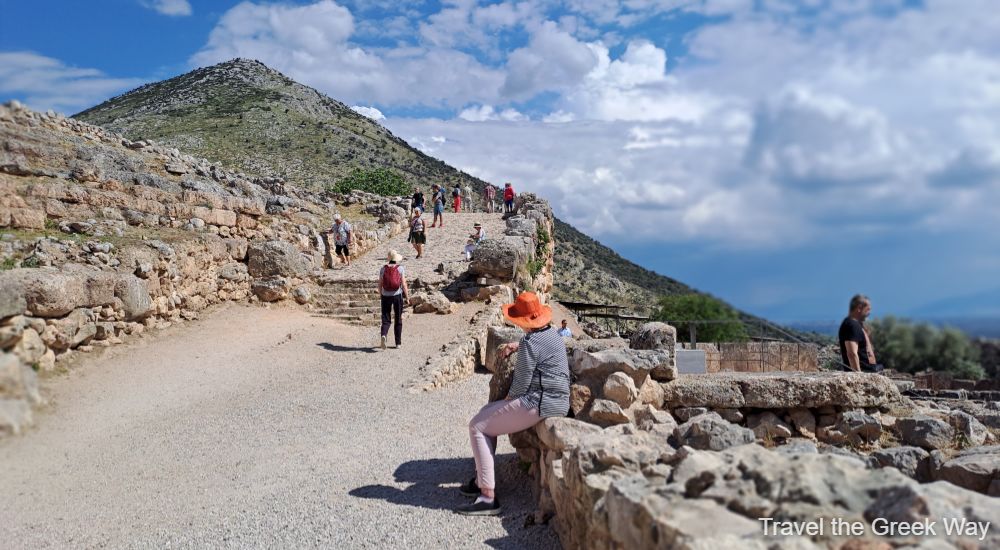
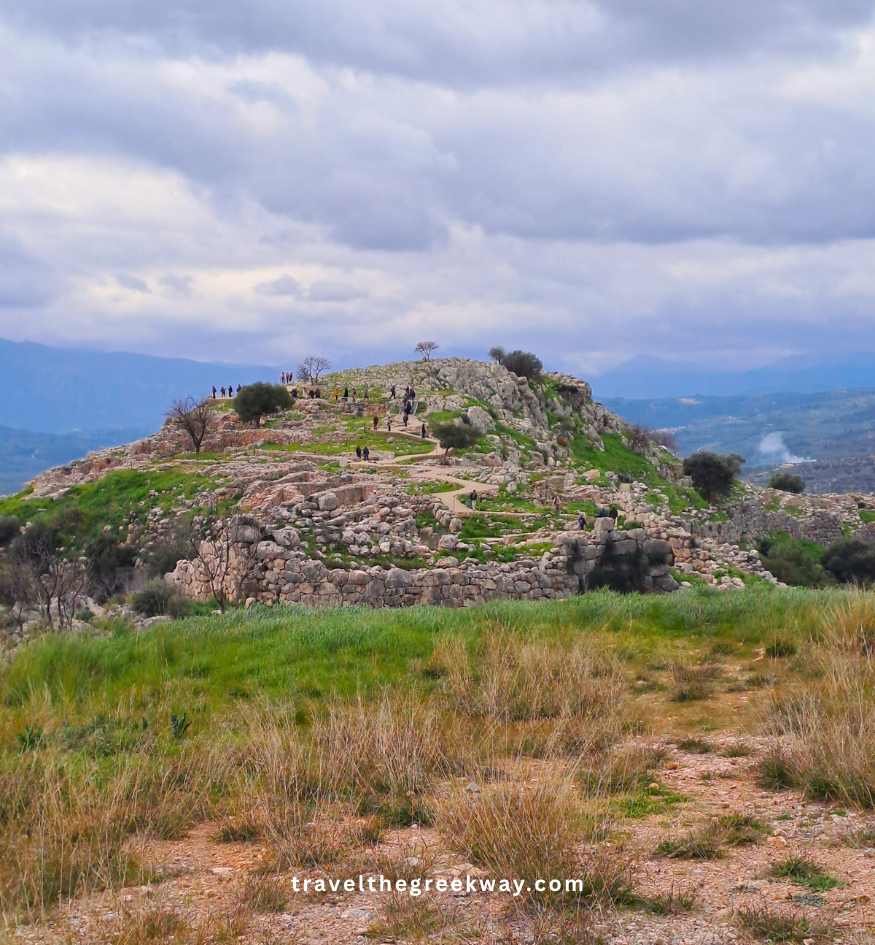
The Palace was built atop the hill and must have been constructed in the 14th century BC. After the Grave Circle A, the path leads you to the southwestern entrance of the palace.
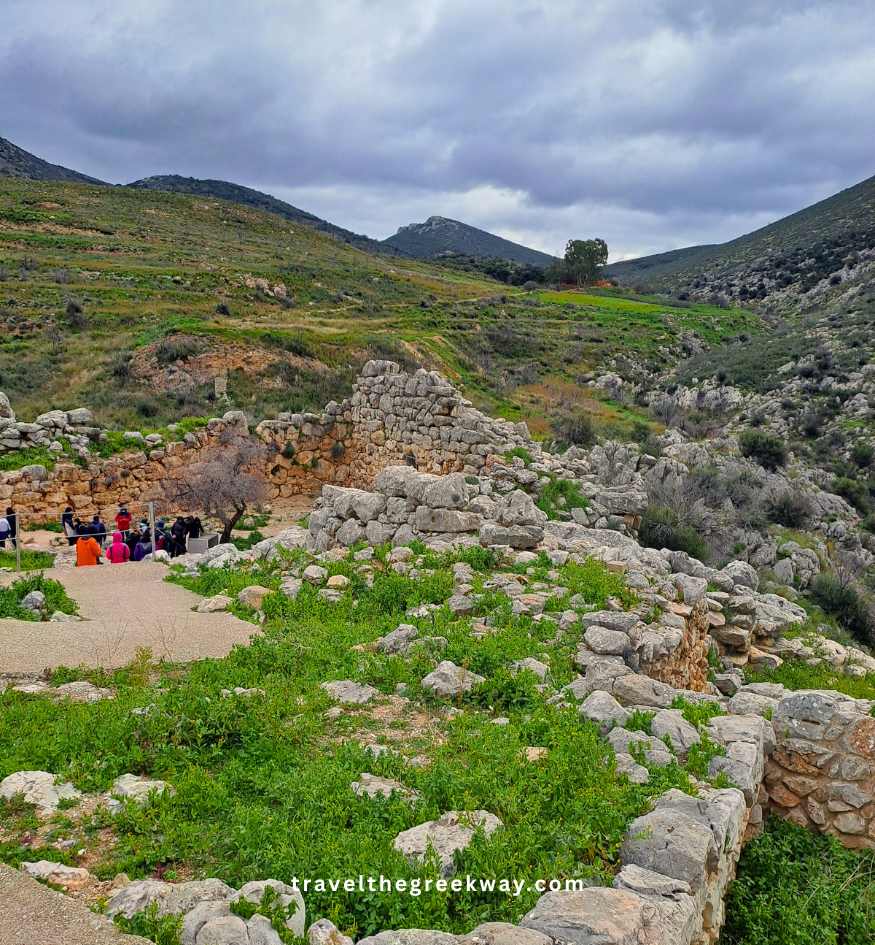
The few remains of the Palace indicate that there was a throne room, landings and staircases, a shrine, a hearth, guest chambers, and storerooms.
It is a bit uphill and if you are visiting during summer, take a lot of water with you, and a hat.
The Museum
The on-site Archaeological Museum sits just north of the Acropolis of Mycenae and offers a great introduction to everyday life and burial customs of the Mycenaeans.
The exhibits are spread across four rooms on two levels, with an easy, circular layout that makes the visit flow smoothly.
Along the way, you’ll also find helpful educational material and enjoy great views over the areas where the cemeteries of Mycenaean nobles were once located.
Grace Circle B: The Vaulted Tombs
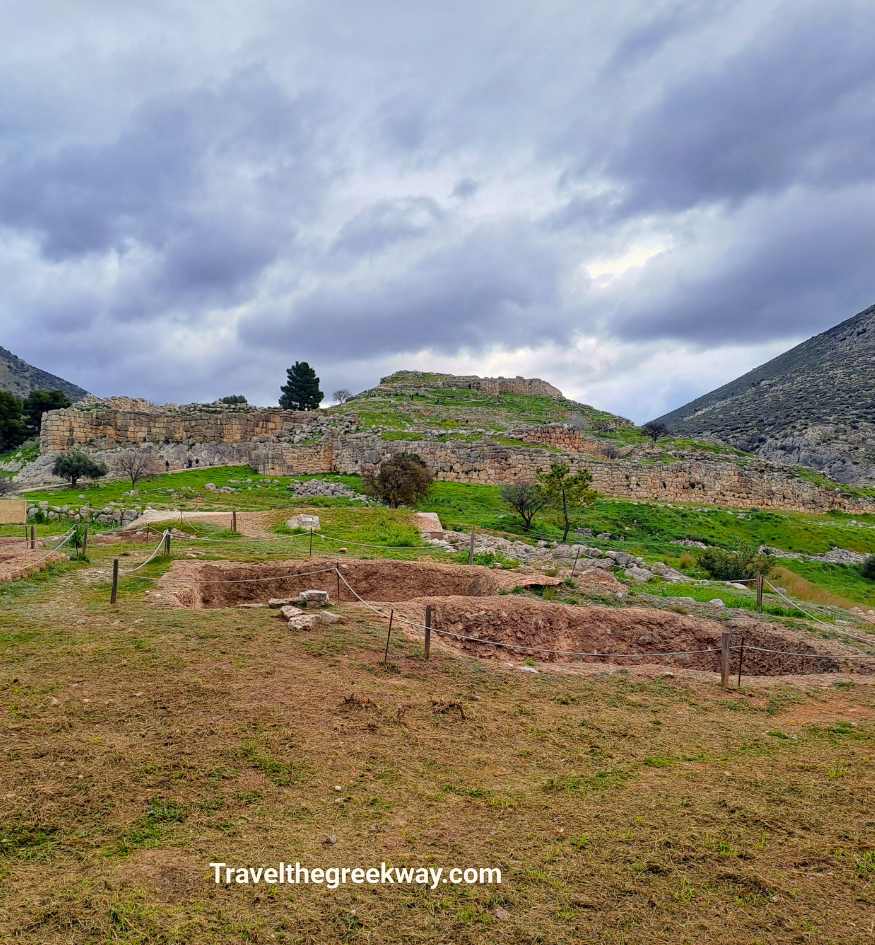
Grave Circle B is located outside the walls of Mycenae and contains 14 pit graves with precious objects of gold, ivory, and rock crystal.
There are also 4 vaulted tombs: the tomb of Aegisthus, of Lions, and Clytemnestra.

While its name implies that Agamemnon’s wife was buried in it, there is no such evidence to prove it. The fourth Tomb is the Treasury of Atreus, the most brilliant and impressive tomb of the Mycenaean civilization.
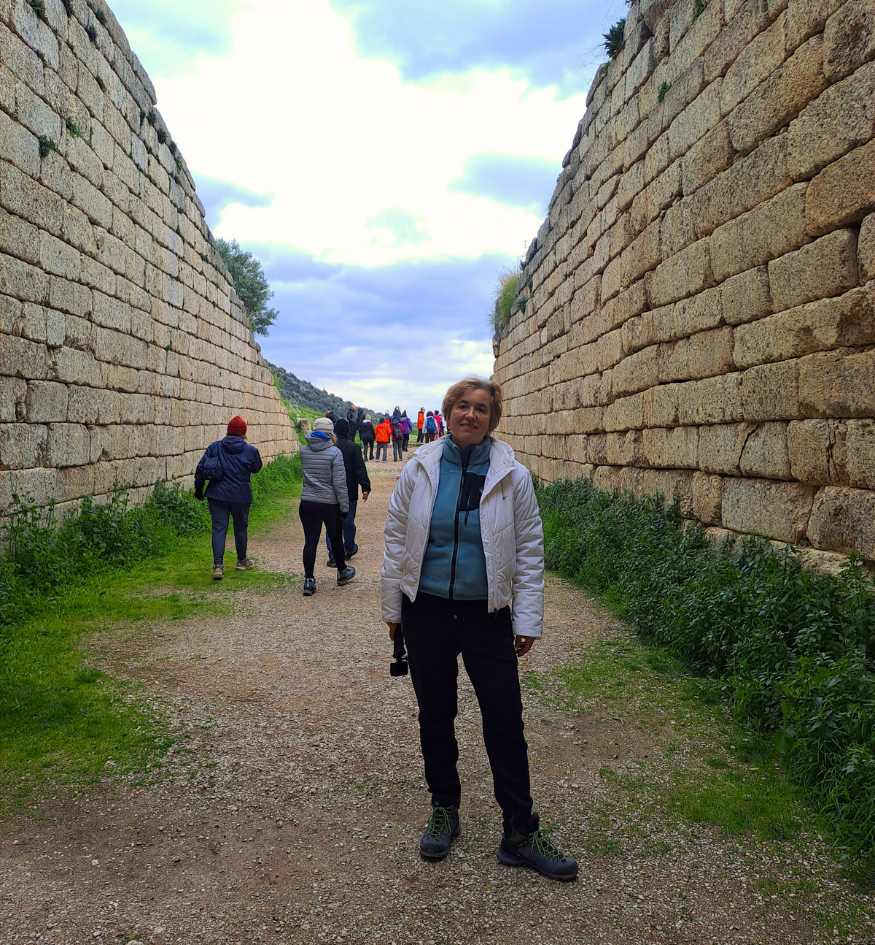
The Tomb of Aigisthos is a smaller tholos tomb near Mycenae, dating to the Late Bronze Age. In Greek mythology, Aigisthos and Clytaemnestra are said to have murdered Agamemnon in his bath after he returned from the Trojan War.
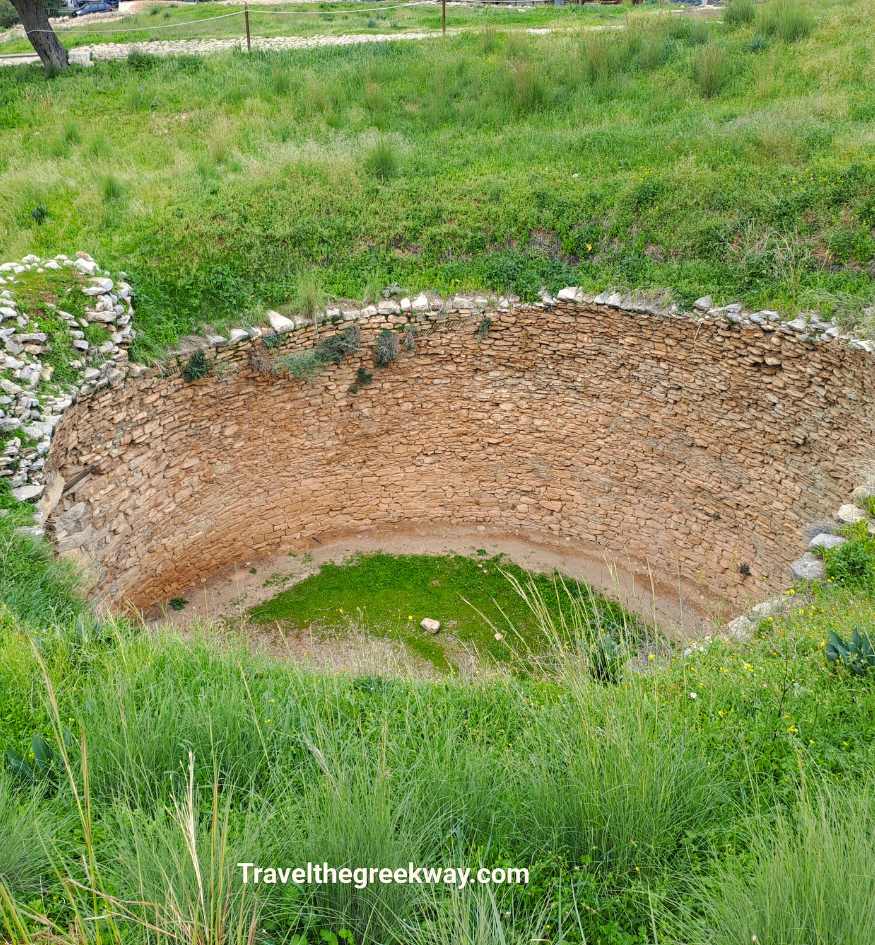
While the tomb is not as grand as the Treasury of Atreus, it’s an important example of Mycenaean burial architecture and adds a strong mythological layer to a visit to the site.
The Treasury of Atreus
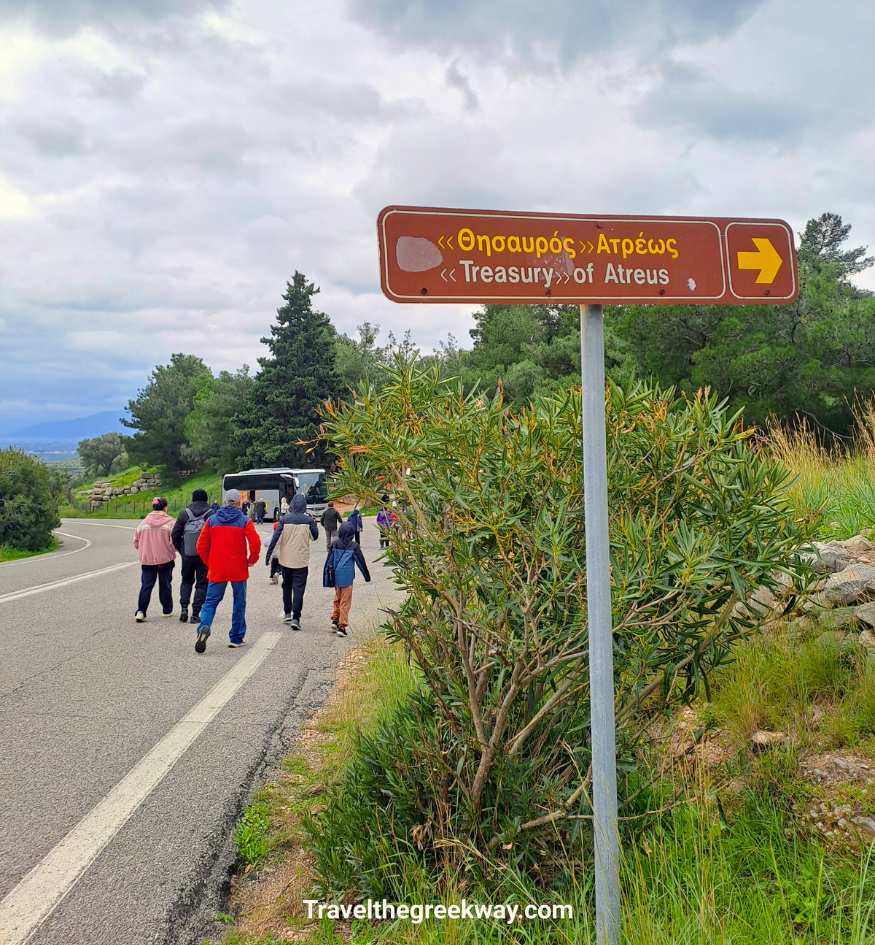
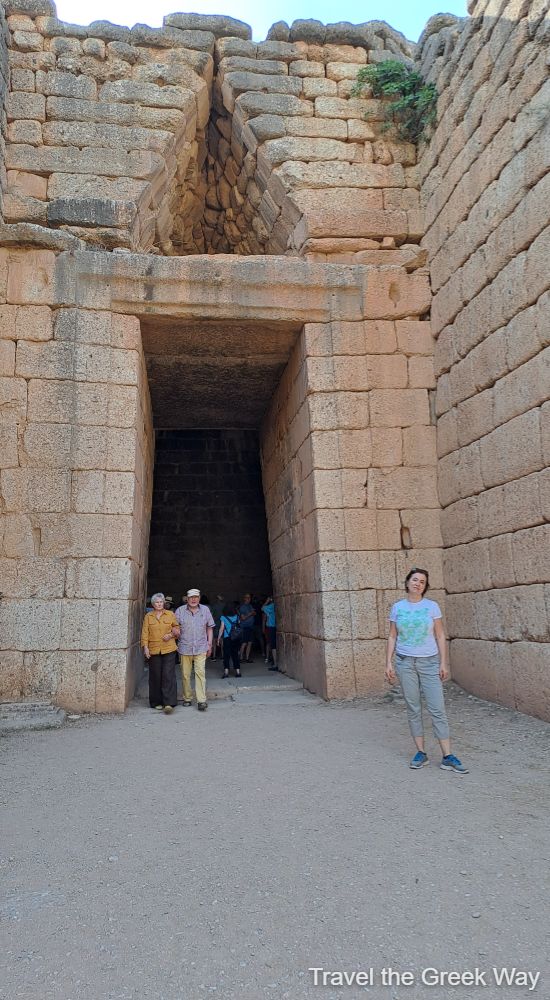
The vaulted tomb of the Treasury of Atreus or Tomb of Agamemnon is built south of the main area of the Mycenaean Site.
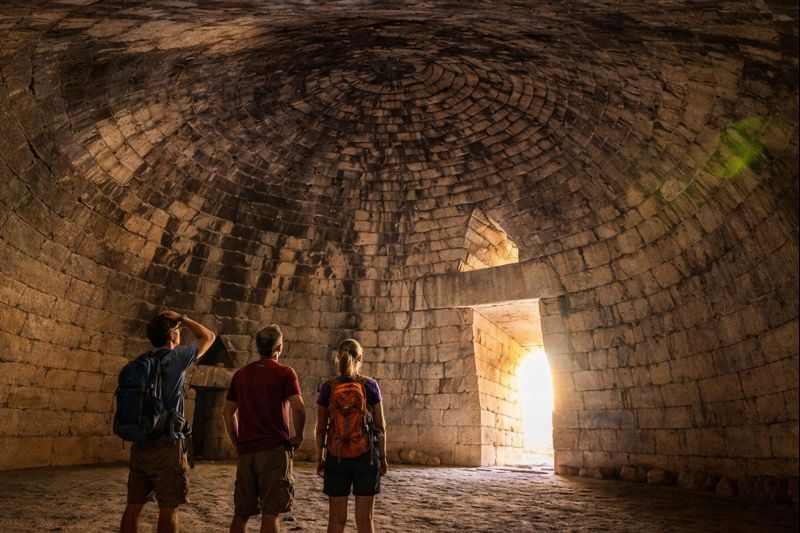
It is dated between 1350 and 1250 BC, and it was certainly used as a burial spot for a royal member.
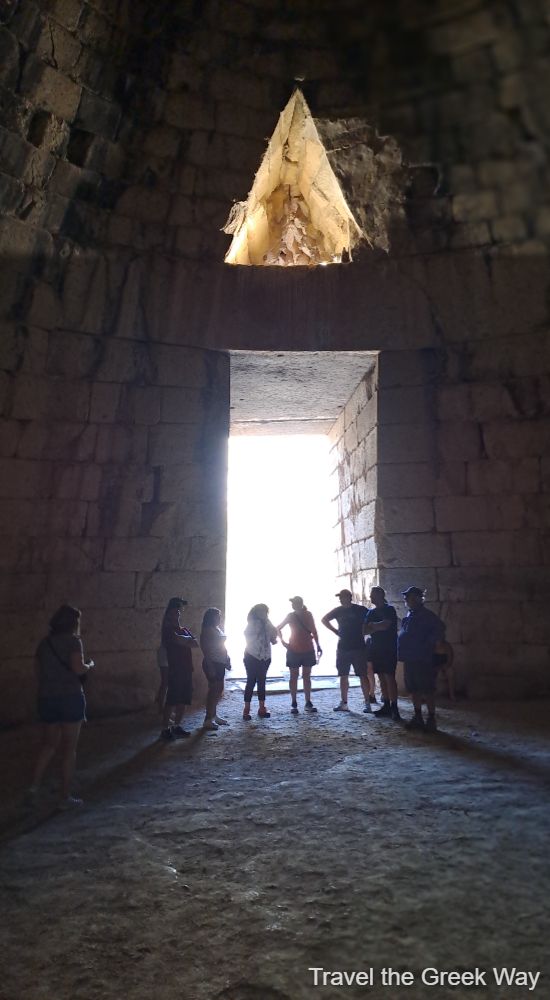
With an internal height of 13.5 meters and a diameter of 14.5 meters, it was the tallest and widest dome in the world for over a thousand years, until the construction of the Pantheon in Rome.
Decline of Mycenae
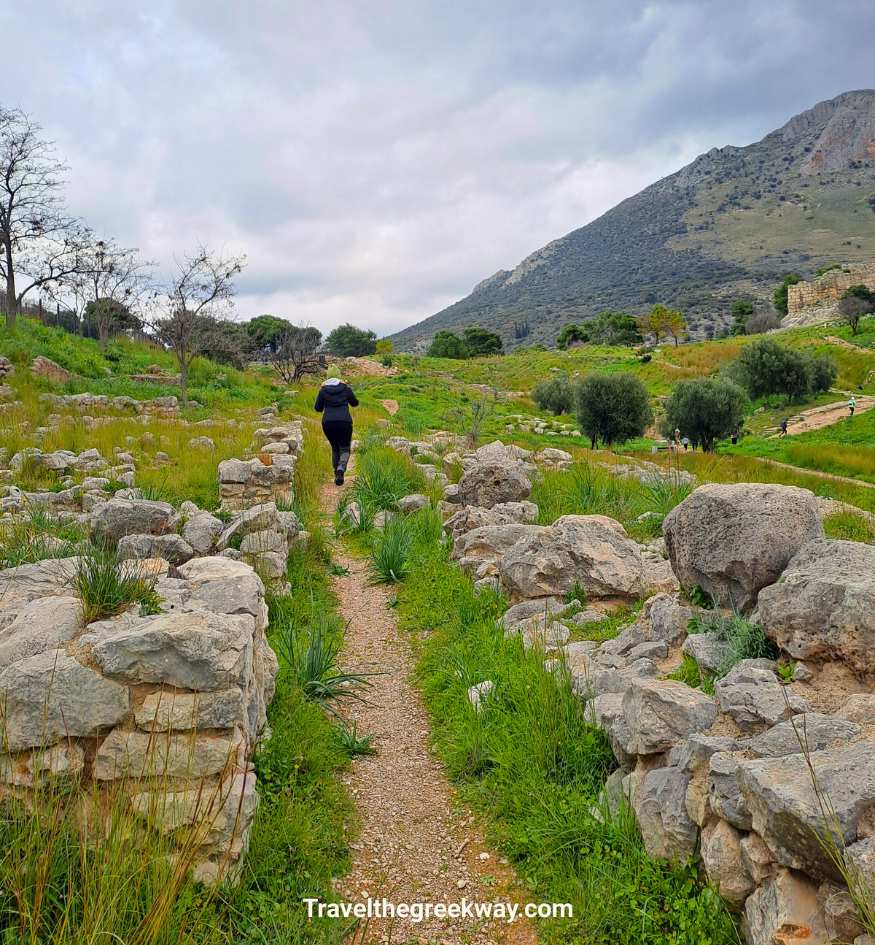
There are a few speculations and research data that explain the decline of Mycenae which began in the 12th century BCE.
Some researchers claim that natural disasters such as earthquakes and decades of drought led to the centers being abandoned. Other scientists attribute it to the movement of new Greek tribes (the descent of the Dorians).
Another political explanation would be the turmoil of the eastern Mediterranean basin, with the fall of the Hittite state and the attacks of the so-called “peoples of the sea” against Egypt.
This upheaval resulted in the decline of Mycenaean trade and the gradual decline of the Mycenaean palaces due to the economic crisis.
Mycenae continued to exist as a small city-state, and the walls were not pulled down. In 480 BCE, Mycenae sent 400 men to fight against the Persians at Thermopylae and Plataea in 479. It was destroyed by Argos City in 468 BCE.
There are traces that during the Hellenistic and Roman periods, Mycenae was revived, but when Greek traveler and geographer Pausanias visited the site about 160 CE, he found it in ruins.
Where Best to Stay in Mycenae
You can visit Mycenae on a day trip from Athens but I strongly advise you to stay overnight in the gorgeous Nafplion, which is just 25 km.
If you love traditional stone houses with superb views below the old town walls, then you will love Marianna Hotel or Klymeni Traditional Homes.
If you prefer to stay centrally at Syntagma Square in Nafplio with beautiful views of Palamidi castle, then you should stay in Xenon Inn.
Mycenaean Civilization FAQ
What is the entrance fee for Mycenae?
The general entrance ticket to Mycenae costs €20, but if you are up to 25 years old or an EU member you may be eligible for a reduced price.
What are the opening hours of Mycenae?
Mycenae is usually open from 8:00 AM to 8:00 PM, depending on the month and daylight hours.
Are there facilities at the site?
Yes. The site is partially accessible and includes a coffee kiosk, restrooms and a small shop inside the museum.
Can you eat or drink inside Mycenae?
Food and drinks are not allowed inside Greek archaeological sites. Only water is permitted.
Can I pay with a credit card at Mycenae?
Yes, both cash and credit cards are accepted at the entrance.
Where was the Mycenaean civilization located?
What is the best-preserved Mycenaean palace?
The Palace of Nestor in Pylos is considered the best-preserved Mycenaean palace in mainland Greece.
What did Mycenaean cities have in common?
They shared:
A common Greek language (Linear B)
Similar religious beliefs
Comparable political and social systems
Who first excavated Mycenae?
The Lion Gate was cleared in 1841 by Kyriakos Pittakis. Heinrich Schliemann excavated the site in the 1870s, followed by Christos Tsountas, who revealed much of the Mycenaean Acropolis.
Best Guided Tours in the Peloponnese & Delphi
- Epidaurus, Mycenae and Nafplio Small-Group Tour from Athens
- Ancient Sparta & Mystras Private Day Tour from Athens
- 2 Day Private Tour in Delphi, Ancient Olympia and Nafpaktos town
How Long Did the Bronze Age Last?
The Bronze Age in the Aegean lasted about 2.000 years, between c. 3000 and 1000 BCE. It is called the Bronze Age because during this period, the civilizations were either using, producing, or trading bronze.
Which are the Other Bronze Age Civilizations?
The Minoan civilization flourished mainly in Crete and a few other Aegean islands between 3.000 and 1450 BCE until it ended around 1100 BCE. It represents the first advanced civilization in Europe.
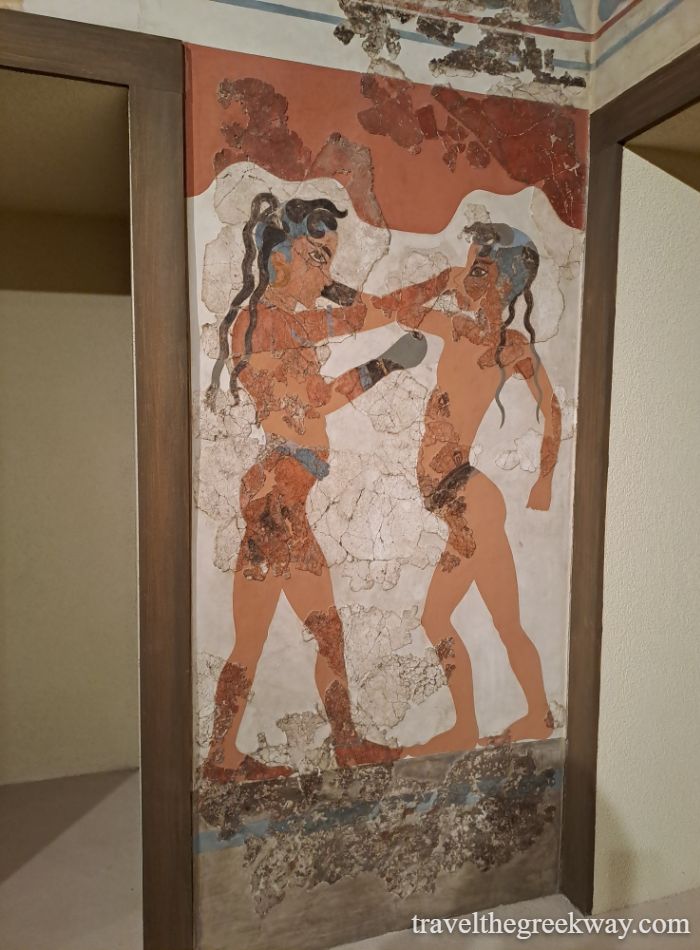
The Cycladic civilization flourished between 3200 and 2000 BCE on the Cyclades Islands. Minoan, Cycladic, and Mycenaean civilizations developed independently and influenced each other.
Some of the other important civilizations in the Mediterranean included the Phoenicians (2500-64 BCE), the Egyptians (3000-332 BCE), and the Mesopotamians (8000-2000 BCE).
Note: Mesopotamia used to be what is modern-day Iraq, Kuwait, and parts of Syria.
Mythological History of Mycenae
According to Pausanias, the mythical Perseus, son of Zeus and Danae, daughter of the king of Argos, founded Mycenae and Tiryns (another UNESCO Mycenaean Site near Nafplio).
Eurystheus, the last king of the Perseid dynasty, was the one who commissioned Herakles (Hercules) to perform his twelve labors (remember the Lion of Nemea?) Eurystheus was killed fighting the Athenians, and Atreus, the son of Pelops, became the king of Mycenae and started the Atreid dynasty.
Atreus’ son, Agamemnon, led the expedition against Troy but was murdered by his wife, Clytemnestra, upon his return to Mycenae.
Film Tip: A masterpiece of Electra of Sophocles was filmed in Mycenae in 1962 and describes the death of Agamemnon and how Electra took revenge. You can watch it on YouTube here.
How to Get to Mycenae
Mycenae is 120 km southwest of Athens and is very easy to get there via the National Road E94. If you rent a car, I use Discover Cars, you can stop along the way to other popular destinations in the area, such as :
- Corinth Canal
- Ancient Corinth and Acrocorinth
- Isthmia Archaeological Site
- Nemea Archaeological Site and Wineries
If you don’t want to drive, you can take the KTEL buses from Athens.
Join Our FB Group & Subscribe to My YouTube Channel!
For more travel to Greece tips and beautiful destinations in the Greek islands please join my FREE Facebook Group or SUBSCRIBE to my YouTube & TikTok channels for amazing videos of Greece! Happy and safe travels, Evgenia.
My Most Popular Posts
- Wine Tasting in Nemea
- Discover Ancient Corinth and Acrocorinth
- 4 Days Peloponnese: Mycenae, Nafplio, Olympia
- 8 Days Peloponnese: Nafplio, Kardamili, Monemvasia
- Top Things to Do in Porto Heli
How to get to Athens Port (Piraeus) from Athens Airport

- Bus: If you are arriving at Athens International Airport you can travel straight to the port by taking the X96 express bus (€5.5, children <6 yo, free entrance), which departs every 40 minutes and the average trip lasts 1 hour – runs 24/7. X93 will take you to Athens center.
- Metro: (€9) is easily found across airport arrivals (blue line – M3) going directly to Piraeus port. The average trip to Piraeus lasts 1 hour.
- Taxis are available in front of the airport (around €45 to Athens, €55 to Piraeus (depending on the traffic in Kifisos), and take up to 3 or 4 people with small luggage)
- Rent a car with Discover Cars for reliable, new cars at affordable prices
- You don’t like driving but love hassle-free solutions? Book a Private transfer with an English-speaking driver from Athens International Airport to Piraeus Ferries, or anywhere else in Greece.
Essential Travel Info for Greece
- ‘Hello’ and ‘Thank You’ in Greek: “Ya sou” and “Efharisto”
- Booking.com: I use Booking.com mostly for Europe.
- All-Inclusive Resorts in Greece
- Rent an Affordable Car in Greece
- Athens Metro Website (timetables and ticket info)
- Trains (Hellenic Train)
- Public Buses KTEL
- Get Your Guide: For all your day or multi-day tours and city guide needs, I use Get Your Guide
- Emergency Numbers Anywhere in Greece: AMBULANCE 166 – FIRE 199 – POLICE 100– EMERGENCY NUMBER 112
